
English can be tricky, especially with words that look almost right. One common confusion is flies or flys—which one should you actually use?
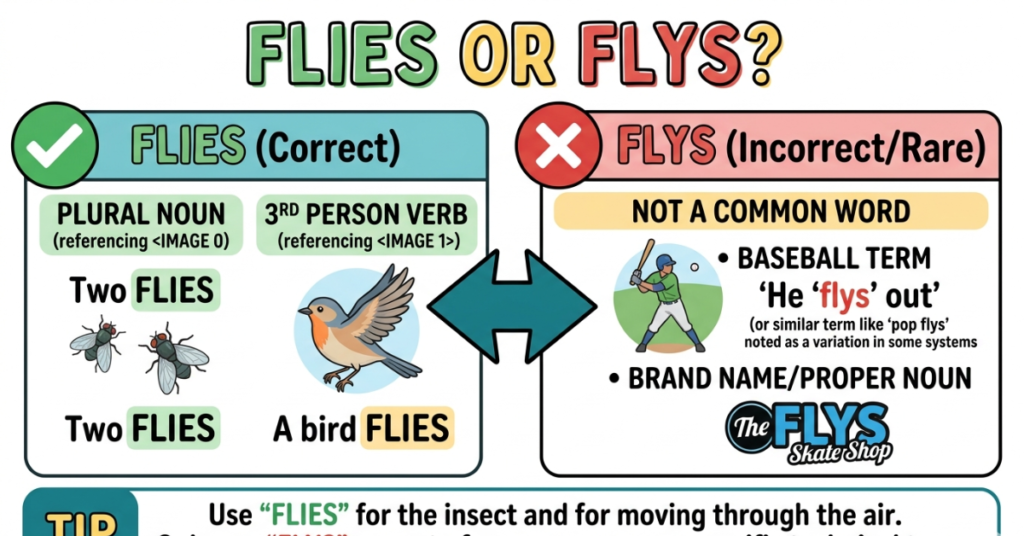
Let’s clear it up right away: “flies” is the correct spelling in most cases, while “flys” is almost always incorrect. But there are a few details worth understanding so you never second-guess yourself again.
Flies or Flys: Which Is Correct?
If you’re asking is it flies or flys, here’s the simple answer:
Correct:
- flies
Incorrect:
- flys (in standard grammar)
So whether you’re writing about insects, airplanes, or actions, “flies” is the form you’ll usually need.
Why “Flies” Is Correct (Grammar Rule)
The confusion comes from how English forms plurals and verb endings.
The rule:
When a word ends in a consonant + y, you:
- Change y → ies
Examples:
- fly → flies
- try → tries
- cry → cries
This applies to both:
- Plural nouns (more than one fly)
- Third-person verbs (he/she/it flies)
Flies or Flys Meaning Explained
To understand both of words meaning, you need to know how “flies” works in different contexts.
1. As a noun (insect):
- “There are many flies in the room.”
Here, it refers to more than one fly.
2. As a verb (action):
- “She flies to Dubai every month.”
- “The plane flies at high altitude.”
This is the present tense form for:
- He / She / It
Time Flies or Flys: Which One Is Right?
This is one of the most searched phrases: time flies or flys.
Correct:
- “Time flies.”
Incorrect:
- “Time flys.”
So phrases like:
- “Crazy how time flies”
- “My, how time flies”
- “Time sure flies”
…are all correct using flies.
Examples: Flies in Everyday Sentences
Let’s look at real usage to make things crystal clear.
Correct examples:
- “He flies a plane professionally.”
- “A plane flies over the city every hour.”
- “She flies to work instead of driving.”
- “The bird flies across the sky.”
These cover common searches like:
- he flies or flys
- the airplane flies or flys
When (If Ever) Is “Flys” Used?
Here’s the honest truth: “flys” is rarely correct in modern English.
Possible exceptions:
- Proper names (e.g., a brand or surname)
- Typos or informal writing
In standard grammar, you should always use “flies.”
Flies or Flys in Aviation Context
If you’re talking about planes, the rule stays the same.
Correct:
- “The airplane flies at 35,000 feet.”
- “A plane flies faster than a car.”
So for queries like flies or fly plane, the answer is always flies.
Quick Grammar Cheat Sheet
Here’s a simple way to remember:
- fly (base form)
- flies (he/she/it form OR plural noun)
- flys (incorrect)
Common Mistakes to Avoid
Mistakes:
- time flys
- she flys
- airplane flys
Correct versions:
- time flies
- she flies
- airplane flies
One small spelling change makes a big difference.
FAQs About Flies or Flys
1. Is it flies or fly?
The correct spelling is flies.
2. Why is “flys” incorrect?
Because words ending in consonant + “y” change to “ies” in plural and verb forms.
3. Is it “time flies” or “time flys”?
The correct phrase is “time flies.”
4. Can “flys” ever be correct?
Only in rare cases like names, not in standard grammar.
5. Is “flies” used for both noun and verb?
Yes—it can mean multiple insects or the action of flying.
Final Thoughts: Keep It Simple and Stick With “Flies”
So, flies or flys—what’s the final answer? It’s almost always “flies.” Whether you’re talking about insects, airplanes, or expressions like “time flies,” this is the form you need.
English spelling has its quirks, but once you understand the pattern, it becomes second nature. The next time you write it, you won’t even have to think twice.
Want to sharpen your grammar even more? Keep exploring these small rules—they make a big impact on clear, confident writing.