
Ever noticed how adding just two letters can completely flip a word’s meaning? That’s exactly what happens with the prefix “dis.” If you’ve ever wondered what does the prefix dis mean, you’re in the right place. This small but powerful prefix is widely used in English to create opposites, show absence, or indicate removal. Understanding it can instantly boost your vocabulary and make reading and writing much easier.
What Does the Prefix “Dis” Mean?
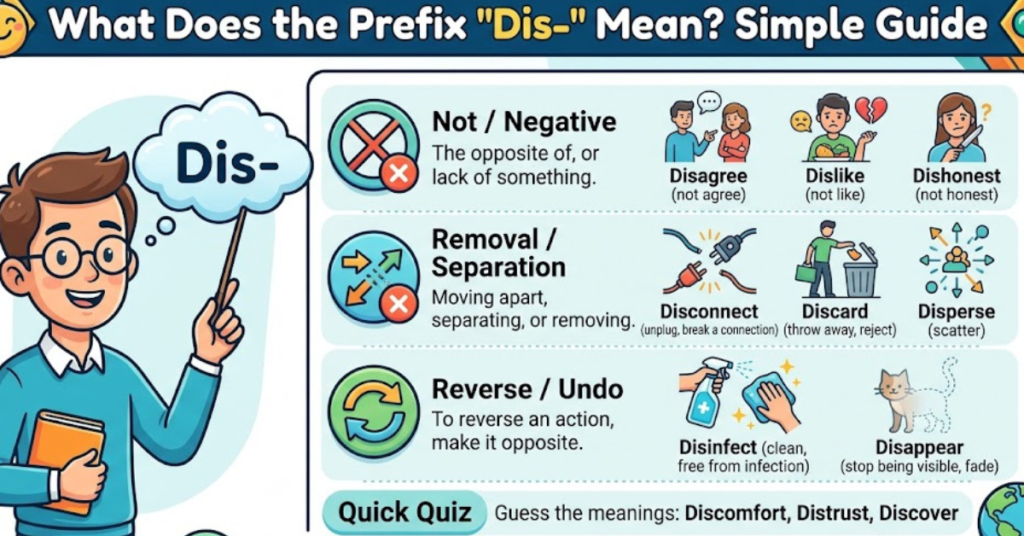
The prefix “dis” is added to the beginning of a word to change its meaning. Most commonly, it means:
- Not / opposite of
- Lack of / absence of
- Removal or separation
It comes from Latin, where “dis” carried similar meanings of negation and reversal.
Common Meanings of the Prefix “Dis”
1. “Dis” Means Not or Opposite
One of the most frequent uses of “dis” is to create the opposite of a word.
Examples:
- Agree → Disagree (not agree)
- Honest → Dishonest (not honest)
- Appear → Disappear (not appear / vanish)
This usage is especially helpful when forming antonyms.
2. “Dis” Indicates Lack or Absence
Sometimes, “dis” shows that something is missing or lacking.
Examples:
- Comfort → Discomfort (lack of comfort)
- Interest → Disinterest (lack of interest)
- Respect → Disrespect (lack of respect)
In these cases, the prefix highlights a negative condition or absence.
3. “Dis” Means Removal or Separation
Another meaning of “dis” involves taking something away or apart.
Examples:
- Connect → Disconnect (remove connection)
- Assemble → Disassemble (take apart)
- Engage → Disengage (separate or withdraw)
This meaning is common in technical, mechanical, and everyday contexts.
How to Use the Prefix “Dis” Correctly
Using “dis” effectively is simple once you understand its purpose. Here are a few practical tips:
- Check the base word: Make sure the original word makes sense with “dis” added.
- Understand context: “Dis” can slightly change meaning depending on usage.
- Avoid overuse: Not every word works with “dis,” so rely on standard usage.
Words That Commonly Use “Dis”
Here’s a quick list of frequently used words with the prefix “dis”:
- Dislike
- Disapprove
- Disappear
- Disrespect
- Disobey
- Discomfort
- Disconnect
- Disagree
These examples show how versatile the prefix is across different contexts.
Why Learning the Prefix “Dis” Matters
Understanding what does the prefix dis mean can significantly improve your language skills. It helps you:
- Expand vocabulary quickly
- Understand unfamiliar words
- Improve reading comprehension
- Write more clearly and accurately
Instead of memorizing thousands of words, learning prefixes like “dis” gives you a shortcut to understanding many at once.
FAQs
1. What does the prefix “dis” mean in simple terms?
It usually means “not,” “opposite of,” or “lack of,” and sometimes “removal.”
2. Is “dis” always negative?
Most of the time, yes. It often gives a negative or opposite meaning to a word.
3. Can “dis” be used with any word?
No, only certain words accept the prefix “dis.” It depends on standard English usage.
4. What is the origin of the prefix “dis”?
It comes from Latin, where it was used to indicate separation, negation, or reversal.
5. What are some easy examples of “dis” words?
Common examples include dislike, disagree, disconnect, and disappear.
Conclusion
So, what does the prefix dis mean? In short, it’s a powerful tool that usually signals negation, absence, or reversal. By learning how it works, you can quickly decode unfamiliar words and sharpen your communication skills.
If you want to keep improving your vocabulary, start paying attention to prefixes like “dis” in everyday reading—you’ll be surprised how much easier English becomes.