
It’s easy to mix up redact vs retract—they sound similar, but using the wrong one can completely change your meaning. Imagine trying to remove sensitive information but accidentally implying you’re taking back a statement. That’s a big difference.
In this article, we’ll break down redact vs retract, explain what each term really means, and show you exactly when to use them. By the end, you’ll be able to use both words confidently in everyday writing, legal contexts, and professional communication.
What Does “Redact” Mean?
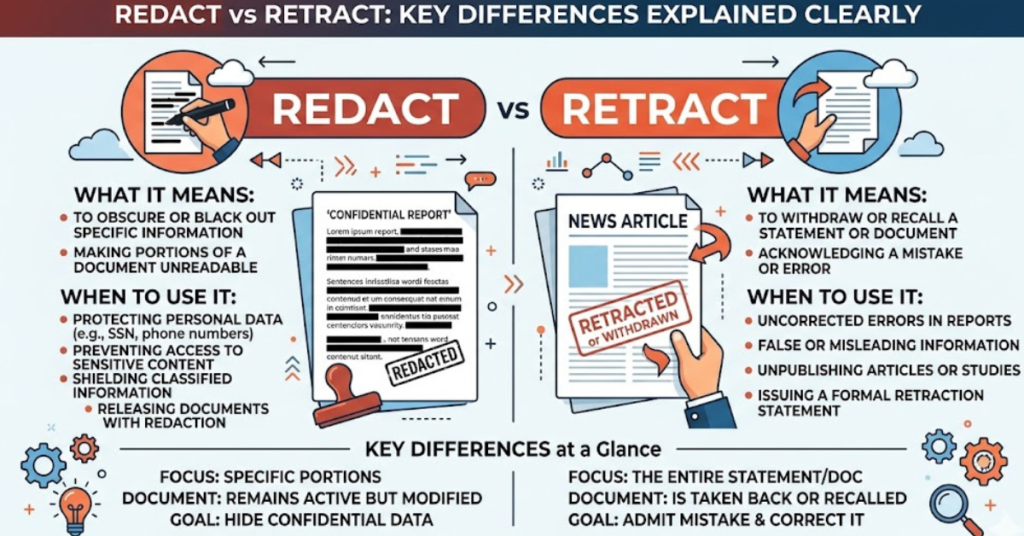
Redact means to edit or remove sensitive or confidential information from a document before it is shared or published.
This term is commonly used in legal, government, and corporate settings.
Key Features of Redaction:
- Removes private or classified information
- Keeps the rest of the document intact
- Often replaces removed text with black bars or blanks
Example Sentences:
- The lawyer redacted personal details from the contract.
- The report was released after being carefully redacted.
Common Contexts:
- Legal documents
- Government files
- Medical records
- Corporate reports
What Does “Retract” Mean?
Retract means to take back or withdraw a statement, claim, or accusation—usually because it’s incorrect or inappropriate.
It’s often used in journalism, public statements, and formal communication.
Key Features of Retraction:
- Involves admitting an error or mistake
- Applies to statements, not documents
- Often includes a correction or apology
Example Sentences:
- The newspaper retracted the false claim.
- He publicly retracted his earlier statement.
Common Contexts:
- News articles
- Public speeches
- Academic publications
- Social media apologies
Redact vs Retract: Key Differences
Understanding redact vs retract becomes much easier when you compare them side by side.
| Feature | Redact | Retract |
| Meaning | Remove sensitive information | Take back a statement |
| Usage | Documents | Statements or claims |
| Purpose | Protect privacy/confidentiality | Correct or admit an error |
| Common Fields | Legal, corporate, government | Media, public communication |
When Should You Use Redact?
Use redact when you need to hide or remove specific parts of a document without discarding the entire content.
Situations Where Redaction Is Appropriate:
- Sharing legal documents with private data
- Publishing reports with confidential details
- Protecting personal information in public records
When Should You Use Retract?
Use retract when you need to withdraw something you’ve said or written because it’s wrong or misleading.
Situations Where Retraction Is Appropriate:
- Correcting false information in an article
- Taking back a public statement
- Fixing an academic or research error
Common Mistakes to Avoid
Even experienced writers confuse redact vs retract. Here are a few pitfalls:
- Saying “redact a statement” when you mean “retract it”
- Using “retract” when referring to removing text from a document
- Assuming both words mean “delete”
Quick Tip:
- If it’s about documents → redact
- If it’s about statements → retract
Why the Difference Matters
Using the wrong term can lead to misunderstandings—especially in professional or legal situations.
For example:
- Saying a report was “retracted” suggests it was withdrawn entirely
- Saying it was “redacted” means it’s still available but edited
That’s a huge distinction, particularly in law, journalism, and business communication.
Related Terms and LSI Keywords
To better understand redact vs retract, here are some related terms:
- Edit vs delete
- Withdraw vs remove
- Confidential information
- Public correction
- Legal redaction
- Statement withdrawal
These terms often appear in similar contexts and help reinforce the meaning of each word.
FAQs
1. What is the main difference between redact vs retract?
The main difference is that redact means removing sensitive information from a document, while retract means taking back a statement or claim.
2. Can you redact a statement?
Not exactly. You redact parts of a document, not the act of making a statement. If you want to take back a statement, you retract it.
3. Is redaction the same as deletion?
No. Redaction removes specific information while keeping the rest of the document intact. Deletion removes everything.
4. Why do newspapers retract articles?
They retract articles to correct errors, misinformation, or false claims and maintain credibility.
5. Is redaction used only in legal documents?
No. While common in legal settings, redaction is also used in healthcare, business, and government documents.
Conclusion
Understanding redact vs retract is more than just a vocabulary lesson—it’s about communicating clearly and accurately.
- Redact is all about editing documents to protect sensitive information
- Retract is about taking back statements when they’re incorrect
Using these terms correctly helps you sound more professional and avoids costly misunderstandings.
If you found this guide helpful, consider exploring related topics like legal writing tips or common word confusions to sharpen your communication skills even further.