
Ever noticed how two words can mean almost the same thing—but still feel completely different? That’s where nuanced synonyms come into play.
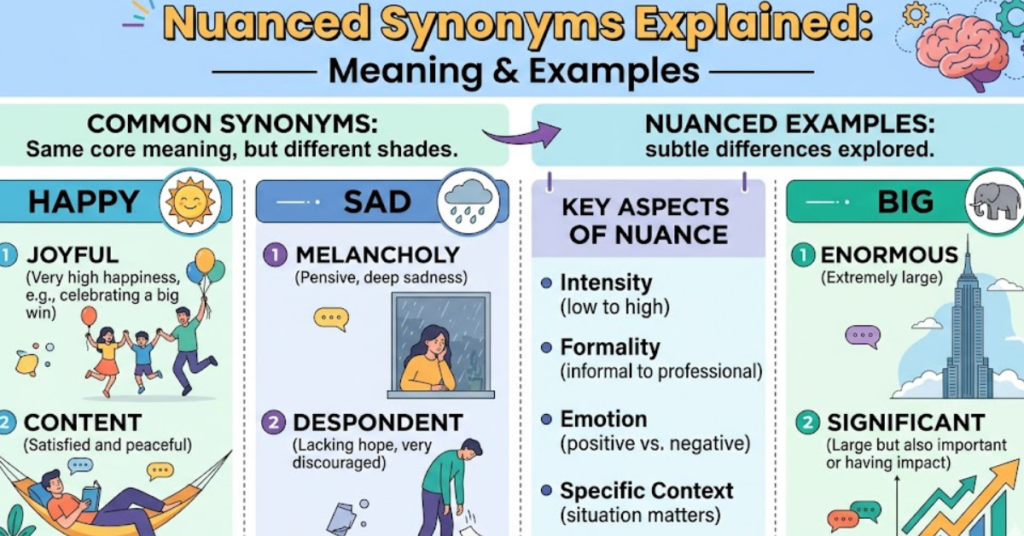
The keyword nuanced synonyms refers to words that share similar meanings but carry subtle differences in tone, emotion, intensity, or context. These small variations are what make writing sound natural, expressive, and precise instead of flat or repetitive.
In this guide, we’ll break down what nuanced synonyms are, why they matter, and how you can use them to sharpen your vocabulary and communication skills.
What Are Nuanced Synonyms?
At a basic level, synonyms are words with similar meanings. But nuanced synonyms go a step further—they don’t just match in definition, they differ in feeling and usage.
For example:
- “Angry,” “irritated,” and “furious” all describe emotion—but at different intensity levels.
- “Walk,” “stroll,” and “march” describe movement—but with different tone and purpose.
These subtle differences are what linguists call lexical nuance.
Why nuance matters in language
Nuance helps you:
- Express emotions more accurately
- Avoid repetitive writing
- Match tone to context
- Improve clarity and readability
Why Nuanced Synonyms Matter in Writing
Using nuanced synonyms is one of the simplest ways to make your writing more engaging and professional.
1. They improve clarity
Instead of saying:
- “He was very happy.”
You can say:
- “He was delighted.”
- “He was overjoyed.”
Each version paints a slightly different picture.
2. They add emotional depth
Words carry emotional weight. Compare:
- “Scared” vs. “terrified”
- “Sad” vs. “heartbroken”
The second word in each pair intensifies the emotion dramatically.
3. They prevent repetition
Repeating the same word makes writing dull. Nuanced synonyms keep your content fresh and dynamic.
Common Examples of Nuanced Synonyms
Let’s look at some practical examples to understand how subtle differences work in real usage.
Emotion-related nuanced synonyms
- Happy → content, joyful, ecstatic
- Sad → downcast, sorrowful, devastated
- Angry → annoyed, furious, enraged
Action-related nuanced synonyms
- Run → jog, sprint, dash
- Look → glance, stare, observe
- Speak → whisper, talk, shout
Size or intensity
- Big → large, huge, enormous
- Small → tiny, miniature, slight
- Important → significant, crucial, vital
Each synonym fits a different context, even if the general meaning overlaps.
How to Use Nuanced Synonyms Effectively
Understanding nuanced synonyms is one thing—using them correctly is another.
1. Consider tone and context
Ask yourself:
- Is the situation formal or casual?
- Do I want strong emotion or subtle expression?
For example:
- “He shouted” fits anger or urgency
- “He exclaimed” feels more expressive but less aggressive
2. Match intensity carefully
Don’t overuse strong words. Saying “furious” when someone is only mildly annoyed can feel exaggerated.
3. Read widely
Books, articles, and quality writing expose you to natural synonym usage. This builds intuition over time.
4. Use a thesaurus wisely
A thesaurus is helpful, but not every synonym is interchangeable. Always check meaning and context.
Nuanced Synonyms in Everyday Communication
You don’t need to be a writer to benefit from nuanced synonyms. They improve everyday speech and writing too.
In conversations
Instead of saying:
- “I’m tired.”
You might say:
- “I’m exhausted.” (very tired)
- “I’m drained.” (emotionally or physically low)
In professional writing
Instead of:
- “The project is good.”
Try:
- “The project is effective.”
- “The project is well-executed.”
- “The project is impressive.”
Each version changes how your message is perceived.
Common Mistakes to Avoid
Even though nuanced synonyms are powerful, they can be misused.
1. Overcomplicating sentences
Don’t replace simple words just to sound advanced. Clarity always comes first.
2. Ignoring context
Not all synonyms fit all situations. “Slender” and “thin” may describe size, but one may sound more flattering than the other.
3. Overusing thesaurus replacements
This can make writing feel unnatural or forced.
Tips to Master Nuanced Synonyms
Here’s how you can naturally build your vocabulary:
- Learn words in pairs or groups, not isolation
- Practice rewriting sentences with different synonyms
- Notice tone in movies, books, and conversations
- Keep a personal vocabulary journal
- Use words in real conversations to reinforce memory
FAQs About Nuanced Synonyms
1. What are nuanced synonyms in simple terms?
Nuanced synonyms are words that have similar meanings but differ in tone, intensity, or context.
2. Why are nuanced synonyms important?
They help improve clarity, emotional expression, and writing quality while avoiding repetition.
3. Are all synonyms interchangeable?
No. Even if words are similar, their usage depends on context and tone.
4. How can I learn nuanced synonyms faster?
Read more, practice writing variations, and use a thesaurus carefully with context checking.
5. Do nuanced synonym improve SEO writing?
Yes. They help create more natural, engaging content and improve keyword variation without stuffing.
Conclusion
Understanding nuanced synonyms is a game-changer for anyone who wants to communicate more clearly and effectively. These subtle word differences help you express emotions better, avoid repetition, and improve overall writing quality.
The key takeaway is simple: don’t just choose words that mean the same thing—choose words that feel right in context