
It’s a small detail, but it can make a big difference in your writing: yesterdays or yesterday’s—which one is correct?
If you’ve ever hesitated before typing it, you’re not alone. The confusion usually comes down to one thing: apostrophes. In this guide, we’ll break it all down in plain English so you can use the correct form with confidence every time.
Yesterdays or Yesterday’s: Which Is Correct?
Let’s get straight to the point.
Correct in most cases:
- yesterday’s (with an apostrophe)
Usually incorrect:
- yesterdays (without an apostrophe)
So if you’re asking is it yesterdays or yesterday’s, the answer is typically “yesterday’s.”
What Does “Yesterday’s” Mean?
To understand yesterdays or yesterday’s meaning, you need to know what the apostrophe does.
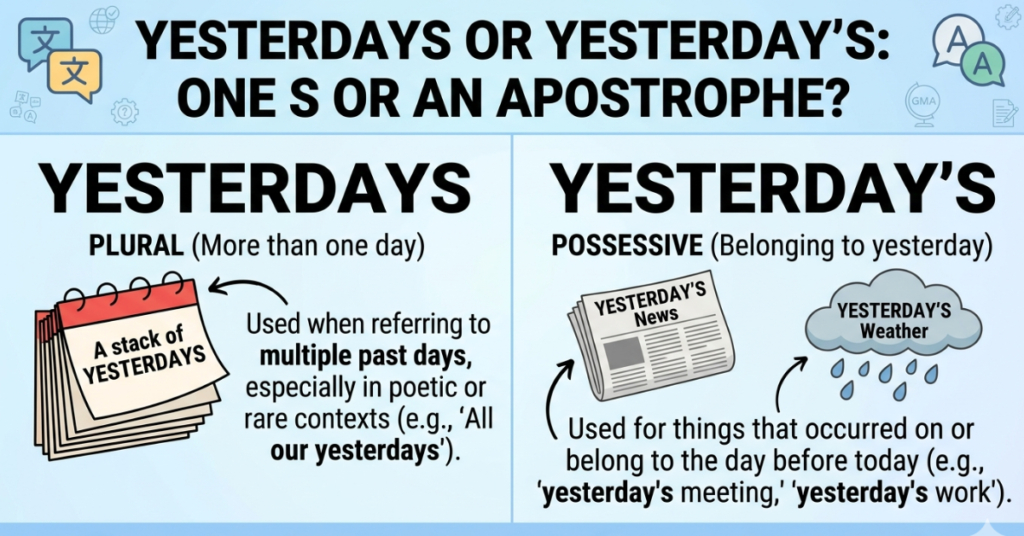
“Yesterday’s” is possessive:
It shows that something belongs to or is related to yesterday.
Examples:
- “I missed yesterday’s meeting.”
- “Did you read yesterday’s news?”
Here, “yesterday’s” describes something connected to the previous day.
Why “Yesterdays” Is Usually Incorrect
Without an apostrophe, “yesterdays” becomes a plural form—but that doesn’t usually make sense.
Why?
- “Yesterday” is a time reference, not something you typically pluralize
- Saying “many yesterdays” is rare and poetic, not standard usage
So in everyday grammar, yesterdays is almost always a mistake.
Yesterdays or Yesterday’s Grammar Explained
Let’s simplify the grammar rule.
Use “yesterday’s” when:
- You’re describing something from yesterday
- You need a possessive form
Structure:
- yesterday + ’s = something belonging to yesterday
Examples:
- “I forgot yesterday’s assignment.”
- “We discussed it in yesterday’s meeting.”
- “Yesterday’s weather was perfect.”
This is why yesterdays or yesterday’s grammar depends on possession—not plurality.
Common Real-Life Examples
Seeing it in context makes everything clearer.
Correct usage:
- “How was yesterday’s meeting?”
- “I didn’t finish yesterday’s work.”
- “Let’s review yesterday’s results.”
Incorrect usage:
- “How was yesterdays meeting?”
- “I missed yesterdays class.”
Apostrophes matter more than you think.
Quick Tip to Remember the Rule
If you’re unsure, ask yourself:
“Does this refer to something from yesterday?”
If yes, use:
- yesterday’s
If not, rethink the sentence.
When Can “Yesterdays” Be Used?
While rare, “yesterdays” can appear in poetic or literary contexts.
Example:
- “We long for the yesterdays of our youth.”
But in everyday writing, emails, or professional communication, this usage is uncommon.
Common Mistakes to Avoid
Here are a few quick pitfalls:
Mistakes:
- Missing the apostrophe
- Confusing plural with possessive
- Overthinking simple sentences
Fix:
- Use yesterday’s for anything related to the previous day
FAQs About Yesterdays or Yesterday’s
1. Is it yesterdays or yesterday’s?
In most cases, yesterday’s is correct.
2. What does “yesterday’s” mean?
It shows something belonging to or related to yesterday.
3. Is “yesterdays meeting” correct?
No, it should be “yesterday’s meeting.”
4. Can “yesterdays” ever be correct?
Only in rare poetic or literary contexts.
5. Why is the apostrophe important?
It indicates possession, which changes the meaning of the word.
Final Thoughts: A Small Detail That Makes a Big Difference
So, yesterdays or yesterday’s—what’s the final answer? In almost every situation, “yesterday’s” is the correct choice.
It’s a simple rule: if you’re talking about something from yesterday, use the possessive form. Once you get used to it, it becomes second nature.
Want to sharpen your grammar even more? Keep practicing these small distinctions—they’re what turn good writing into great writing.