
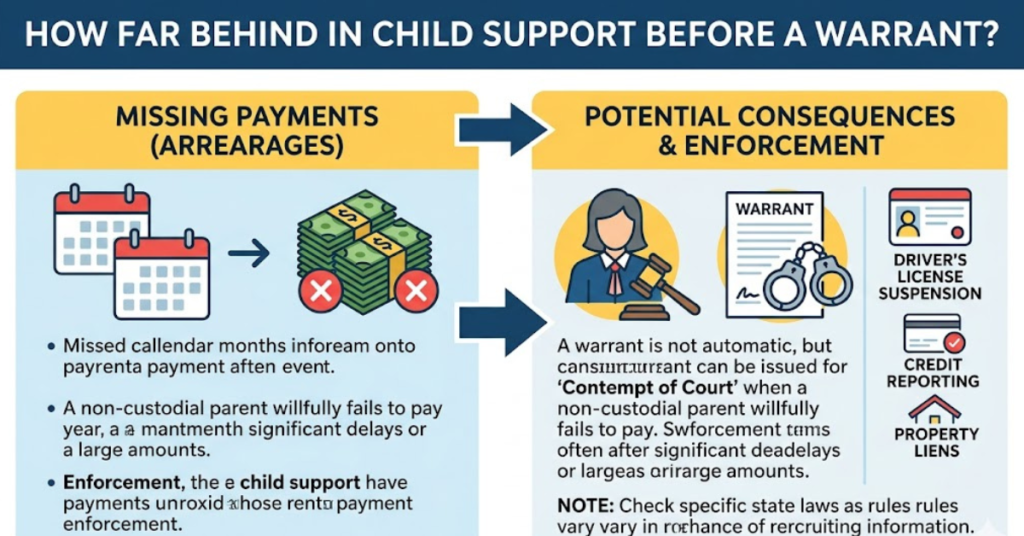

Missing a child support payment can feel overwhelming, but many parents worry about a more serious question: how far behind in child support before a warrant is issued? The answer isn’t always simple because child support enforcement varies by state, court orders, and the amount owed. However, there are common thresholds and legal triggers that courts typically use before issuing a warrant.
In this guide, we’ll break down when warrants happen, how much overdue child support can trigger legal action, and what steps you can take to avoid escalating penalties.
What Happens When You Fall Behind on Child Support?
When you miss payments, the process usually follows a gradual enforcement path. Courts rarely issue a warrant immediately. Instead, they often apply several enforcement measures first.
Typical steps include:
- Late payment notices
- Wage garnishment
- Tax refund interception
- License suspension (driver’s, professional, or recreational)
- Bank account levies
- Court hearing for contempt
A warrant is usually issued only after repeated nonpayment and failure to comply with court orders.
How Far Behind in Child Support Before a Warrant Is Issued?
There is no single nationwide rule, but many states follow similar guidelines. A warrant may be issued when:
- You are 2–6 months behind in payments
- You owe a significant lump sum (often $2,500 or more)
- You ignore court notices or hearings
- You violate a court order after being instructed to pay
- The court finds you in contempt of court
Common Benchmarks General Guidance
While laws vary, these are common thresholds:
- 30–60 days late → Notices and warnings
- 90 days late → Enforcement actions begin
- 120–180 days late → Court hearing likely
- 6+ months or repeated nonpayment → Warrant possible
Courts focus less on exact timing and more on willful nonpayment — meaning you had the ability to pay but didn’t.
What Type of Warrant Can Be Issued?
If you fall far behind, the court may issue:
1. Bench Warrant
A judge issues this when you:
- Miss a child support hearing
- Fail to comply with a court order
- Ignore payment requirements
This allows law enforcement to arrest you until you appear in court.
2. Civil Contempt Warrant
This is issued when the court believes you intentionally refused to pay. You may be jailed until:
- You pay part of the balance
- You agree to a payment plan
- You attend a compliance hearing
Factors Courts Consider Before Issuing a Warrant
Courts don’t just look at how far behind you are. They also consider:
- Your income and employment status
- Attempts to make partial payments
- Communication with the court
- Medical emergencies or hardship
- Past compliance history
If you’re actively trying to pay, courts are less likely to issue a warrant
Consequences of a Child Support Arrest Warrant
If a warrant is issued, consequences may include:
- Arrest and short-term jail time
- Mandatory court appearance
- Payment of lump sum or bond
- Additional fines and fees
- Increased enforcement monitoring
In some cases, you may be released after paying a “purge amount” — a portion of what you owe.
How to Avoid a Warrant for Child Support
If you’re behind, taking action early can prevent escalation:
- Contact the child support office immediately
- Request a payment plan
- File for modification if income changed
- Make partial payments consistently
- Attend all court hearings
- Keep records of communication
Courts usually prefer compliance over punishment.
Can You Go to Jail for Being Behind on Child Support?
Yes — but only after due process. Jail typically happens when:
- You ignore court orders
- You miss hearings
- You refuse to pay despite ability
Courts generally use jail as a last resort.
FAQs
How many missed child support payments before a warrant?
Usually multiple missed payments (often 3–6 months) plus failure to comply with court orders.
Can a warrant be issued immediately?
Rarely. Courts typically send notices and schedule hearings first.
What amount of unpaid child support triggers arrest?
Often $2,500 or more, but this varies by jurisdiction.
Will I be notified before a warrant is issued?
Yes. Most courts send summons or hearing notices beforehand.
Can I stop a warrant once it’s issued?
Yes. Contact the court or child support agency immediately and arrange payment or a hearing.
Does unemployment prevent a warrant?
Not automatically. You must request a modification — otherwise, the order still applies.
Conclusion
So, how far behind in child support before a warrant is issued? In most cases, warrants occur after several months of nonpayment, ignored court orders, or failure to appear at hearings. Courts prioritize compliance, so communicating early and making partial payments can significantly reduce your risk.
If you’re already behind, the best next step is to contact your local child support agency, request a modification if needed, and stay proactive. Taking action now can help you avoid serious legal consequences and stay on track.