
Ever felt like the word “sad” just isn’t enough to describe what you’re going through? That’s where synonyms for sad come in. English is rich with emotional vocabulary, and understanding different synonyms for sad feelings can help you express yourself more clearly, whether you’re writing, speaking, or simply trying to understand your emotions better.
In this guide, we’ll explore a wide range of sadness-related words, their meanings, and how to use them naturally in everyday language.
Why Learning Synonyms for Sad Matters
Using the same word repeatedly can make your writing feel flat. When you explore synonyms for sad, you unlock deeper emotional expression.
Here’s why it matters:
- Helps you express emotions more accurately
- Improves writing quality and storytelling
- Expands your emotional vocabulary
- Makes communication more engaging
Instead of just saying “sad,” you can describe whether someone feels heartbroken, gloomy, or downcast.
Common Synonyms for Sad and Their Meanings
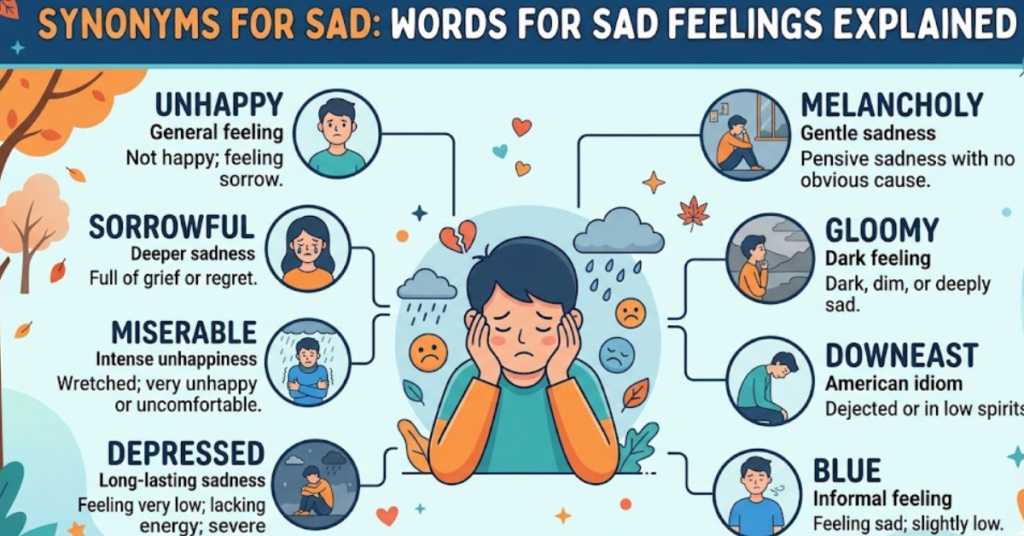
Let’s start with some widely used synonyms for sad feelings and what they actually mean.
1. Unhappy
A general word for not feeling joy or satisfaction.
2. Downcast
Used when someone looks or feels low in spirit.
3. Miserable
A stronger word indicating deep emotional discomfort or distress.
4. Heartbroken
Often used after emotional loss, especially in relationships.
5. Gloomy
Describes a dark, bleak emotional state or atmosphere.
6. Melancholy
A soft, thoughtful sadness that is often reflective.
7. Sorrowful
A formal way to express deep sadness or grief.
Emotional Synonyms for Sad Feelings (Deeper Expressions)
When basic words aren’t enough, these synonyms for sad feelings help describe deeper emotional states:
- Despondent – feeling hopeless or discouraged
- Dejected – low in spirits after disappointment
- Forlorn – lonely and abandoned feeling
- Grief-stricken – overwhelmed with grief
- Woeful – full of sorrow or misery
These words are often used in literature, poetry, and emotional storytelling.
Synonyms for Sad in Everyday Conversation
Not all sadness is intense. Sometimes, we just feel “off.” Here are casual alternatives:
- Feeling down
- Blue
- Low
- Not myself today
- Out of sorts
These are perfect for informal conversations or social media captions.
How to Use Synonyms for Sad Naturally
Using emotional vocabulary effectively is about balance. Here’s how:
Tip 1: Match the intensity
Don’t use “heartbroken” for minor disappointment.
Tip 2: Use context clues
Pair words with situations:
- “She felt melancholy watching the sunset.”
- “He was devastated after the news.”
Tip 3: Avoid overuse
Mix different synonyms for sad feelings to keep writing fresh.
Synonyms for Sad in Literature and Writing
Writers often rely on emotional synonyms to create impact. Here are some examples:
- “The forlorn child waited by the door.”
- “A melancholy silence filled the room.”
- “His voice turned sorrowful as he spoke.”
These words help paint vivid emotional scenes.
Quick List of Synonyms for Sad
Here’s a quick reference list:
- Unhappy
- Miserable
- Heartbroken
- Gloomy
- Melancholy
- Sorrowful
- Dejected
- Despondent
- Downcast
- Woeful
FAQs About Synonyms for Sad
1. What are the best synonyms for sad?
Some of the best include unhappy, gloomy, heartbroken, sorrowful, and melancholy, depending on intensity.
2. What is a stronger word for sad feelings?
Words like grief-stricken, devastated, and despondent express stronger emotional pain.
3. Is “melancholy” the same as sad?
Not exactly. Melancholy is a softer, more reflective form of sadness.
4. Can I use synonyms for sad in formal writing?
Yes, words like sorrowful, dejected, and melancholy are great for formal or literary writing.
5. How do I improve my emotional vocabulary?
Read literature, practice writing, and learn synonyms for common emotions like sadness, happiness, and anger.
Conclusion
Understanding synonyms for sad and synonyms for sad feelings gives you more control over how you express emotions. Instead of relying on a single word, you can choose expressions that truly match your mood or message.
Whether you’re writing a story, journaling your thoughts, or simply trying to communicate better, these words help you sound more natural and expressive. Start practicing them in your daily language, and you’ll quickly notice how much richer your communication becomes.