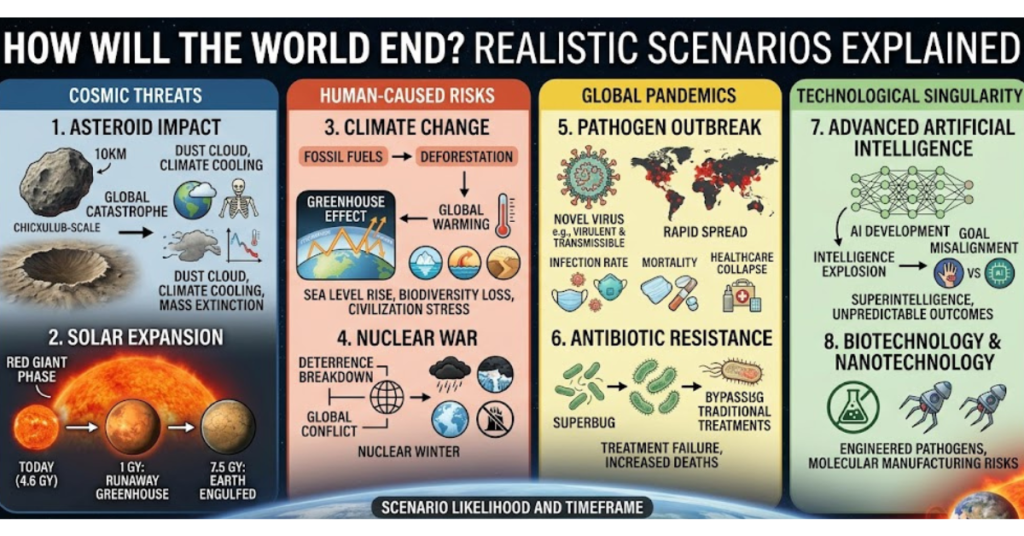

It’s a question that has fascinated humans for centuries: how will the world end? From ancient prophecies to modern science, people have always tried to predict Earth’s final chapter. While movies often dramatize the apocalypse, scientists take a more grounded approach, studying real-world risks that could threaten humanity or the planet itself.
In this article, we’ll break down the most credible scenarios—from cosmic disasters to human-made crises—so you can understand what experts actually say about the end of the world.
: Natural Cosmic Events That Could End the World
: Asteroid or Comet Impact
One of the most well-known answers to how will the world end involves space rocks. Around 66 million years ago, an asteroid impact wiped out the dinosaurs.
What could happen today?
- A large asteroid (10+ km wide) could trigger global fires and a “nuclear winter”
- Dust clouds could block sunlight, collapsing food chains
- Mass extinction would likely follow
Likelihood: Low in the near future, thanks to NASA tracking systems
: Supernova or Gamma-Ray Burst
A nearby exploding star could release deadly radiation toward Earth.
- Gamma-ray bursts can strip away the ozone layer
- Increased UV radiation could devastate life on Earth
Reality check: There are no known nearby stars likely to cause this anytime soon
: The Sun’s Evolution
The most certain answer to how will the world end is tied to the Sun.
- In ~5 billion years, the Sun will expand into a red giant
- Earth could be engulfed or rendered uninhabitable
Bottom line: This is inevitable—but extremely far in the future
: Earth-Based Natural Disasters
: Supervolcano Eruption
Massive volcanic eruptions (like Yellowstone) could disrupt global life.
Potential effects:
- Ash clouds blocking sunlight
- Drastic temperature drops
- Crop failures and famine
: Climate Change and Environmental Collapse
A more immediate concern when asking how will the world end is climate change.
- Rising temperatures and sea levels
- Extreme weather events
- Loss of biodiversity
Important note: This is less about sudden extinction and more about gradual destabilization of human civilization
: Human-Made Threats
: Nuclear War
Perhaps the most immediate existential risk.
Consequences include:
- Massive loss of life
- Nuclear winter reducing global temperatures
- Long-term radiation damage
: Artificial Intelligence Risks
Advanced AI could pose risks if not properly controlled.
- Autonomous systems making harmful decisions
- Loss of human oversight
- Ethical and safety concerns
Current status: Still theoretical, but actively studied
: Biological Threats (Pandemics)
Global pandemics have already shown their impact.
- Engineered or natural viruses
- Rapid global spread due to travel
- Overwhelmed healthcare systems
: Less Likely but Fascinating Theories
When exploring how will the world end, some ideas are more speculative:
- Black holes passing through Earth
- Vacuum decay (a physics-based universe reset)
- Simulation hypothesis shutdown
While intriguing, these remain highly theoretical with little evidence.
: Which Scenario Is Most Likely?
Experts generally agree:
- Short-term risks: Human-made threats (nuclear war, climate change)
- Medium-term risks: Pandemics or environmental collapse
- Long-term certainty: The Sun’s eventual expansion
In other words, the answer to how will the world end depends heavily on the timeframe you’re considering.
: Can We Prevent the End of the World?
Not all scenarios are unavoidable. Humanity has tools to reduce many risks:
What we can do:
- Invest in asteroid detection systems
- Address climate change through global policies
- Promote nuclear disarmament
- Regulate emerging technologies like AI
While we can’t stop cosmic events, we can influence many Earth-based threats.
FAQs
1. How will the world end according to scientists?
Scientists point to several possibilities, including asteroid impacts, climate change, nuclear war, and eventually the Sun’s expansion.
2. When will the world end?
There is no exact date. Some risks exist now, while others (like the Sun’s death) are billions of years away.
3. What is the most likely way the world will end soon?
Human-related risks such as climate change, nuclear conflict, or pandemics are considered the most immediate threats.
4. Could an asteroid destroy Earth?
Yes, but the probability is very low in the near future due to active monitoring systems.
5. Will humans go extinct?
It’s possible, but not inevitable. Human survival depends on how well we manage global risks.
Conclusion
So, how will the world end? The honest answer is that there’s no single path. From cosmic collisions to human mistakes, multiple scenarios could shape Earth’s future. The good news is that many of the most pressing threats are within our control.
Understanding these risks isn’t about fear—it’s about awareness and preparation. If you’re curious to go deeper, consider exploring topics like climate science, space research, or emerging technologies. The more we know, the better equipped we are to protect our future.