
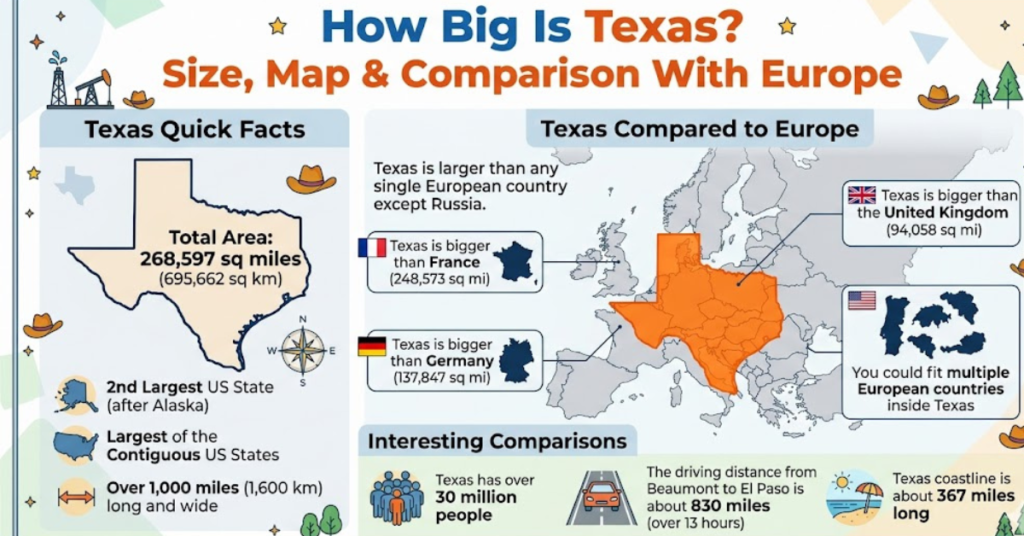

Everything is bigger in Texas — or so the saying goes. But when people ask how big is Texas, they’re often surprised by just how massive the state really is. The Lone Star State isn’t just large compared to other U.S. states; it also rivals entire countries.
This article explores Texas’s total area, compares it with European nations, and explains why it feels so expansive when you travel across it.
Texas Land Area and Dimensions
Texas ranks as the second-largest state in the United States. Its size is impressive by any standard.
- Total area: 268,596 square miles
- In square kilometers: 695,662 km²
- East–west distance: About 773 miles
- North–south distance: About 801 miles
To put that into context:
- Larger than France
- Larger than Germany
- Larger than Spain
- Nearly twice the size of Japan
Driving across the state can easily take half a day or more, depending on your route.
Texas Compared to Europe
Many people are curious about how big is Texas compared to Europe. Europe as a continent is much larger, but the state compares closely with individual countries.
Country-by-Country Comparison
- Bigger than France
- Bigger than Spain
- Bigger than Germany
- Similar to Ukraine
- Slightly smaller than Turkey
Europe covers around 10.18 million km², which makes it roughly 14 times larger overall. Still, Texas alone is bigger than most European nations.
Why Texas Feels So Huge
Numbers don’t tell the whole story. The state feels enormous for several reasons.
Diverse Geography
Texas includes:
- Deserts in the west
- Forests in the east
- Coastal regions along the Gulf
- Plains in the north
- Hill Country in central areas
Long Travel Distances
Examples of driving distances:
- El Paso to Houston → ~745 miles
- Dallas to Brownsville → ~550 miles
- Amarillo to San Antonio → ~500 miles
Spread-Out Cities
Major metropolitan areas are separated by hours of travel, unlike many European regions.
Simple Ways to Visualize Its Size
Here are some relatable comparisons:
- Larger than the United Kingdom
- About twice the size of Italy
- Comparable to combining multiple smaller countries
- Big enough to contain several U.S. states
These examples make the scale easier to picture.
Population vs Size
Despite its huge landmass:
- Population: about 30 million
- Large rural areas remain undeveloped
- Lower density than many European countries
This creates wide-open landscapes and long stretches of highway.
Quick Comparison Table
| Region | Size (km²) | Relative Size |
| Texas | 695,662 | — |
| France | 551,695 | Smaller |
| Germany | 357,022 | Smaller |
| Spain | 505,990 | Smaller |
| Ukraine | 603,500 | Smaller |
| Turkey | 783,562 | Larger |
| Europe | 10,180,000 | Much larger |
FAQs
Is Texas bigger than France?
Yes, Texas has more land area than France.
How long does it take to drive across Texas?
It usually takes 12–14 hours depending on the route.
Is Texas bigger than the UK?
Yes, the state is larger than the United Kingdom.
How does Texas compare with Europe?
Europe is far larger overall, but Texas exceeds many individual countries.
Why is Texas so large?
Its boundaries date back to when it was an independent republic before joining the U.S.
Conclusion
Texas stands out for its enormous land area and wide-open landscapes. While Europe as a continent is much larger, this single U.S. state rivals many nations in size. From long road trips to diverse terrain, its scale is easy to appreciate once you see the comparisons.
Understanding the true dimensions helps put the Lone Star State into perspective — and explains why it has such a big reputation.