
Ever typed a sentence and paused, wondering, “is it stoped or stopped?” You’re not alone. This small spelling detail trips up a lot of writers, especially when dealing with past tense verbs. The confusion around stoped or stopped usually comes down to one simple grammar rule—but if you don’t know it, it can feel like guesswork.
In this guide, we’ll break down the correct spelling, explain why it works, and show you how to avoid this mistake for good.
Stoped or Stopped: Which Is Correct?
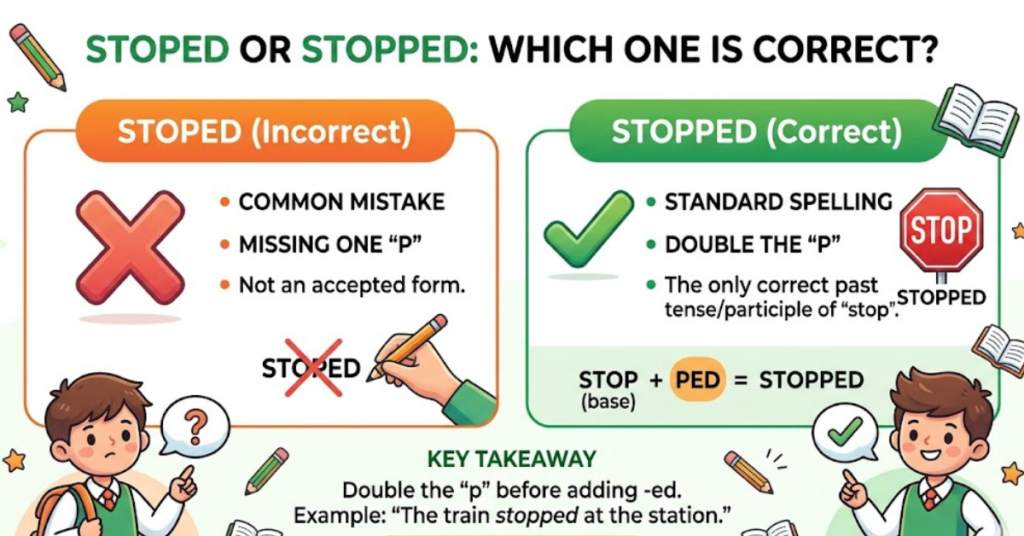
Let’s clear it up right away: “stopped” is the correct spelling, while “stoped” is incorrect.
If you’re asking, which is correct, stoped or stopped?, the answer is always “stopped” in standard English.
Example:
- Correct: She stopped talking when the teacher entered.
- Incorrect: She stoped talking when the teacher entered.
Why “Stopped” Is Correct
The difference between stoped or stopped meaning comes down to a basic spelling rule in English grammar.
When a verb ends in:
- A single vowel + a single consonant
- And the stress is on the final syllable
You double the final consonant before adding “-ed” or “-ing.”
In this case:
- Stop → Stopped (double “p”)
The Rule Behind It (Made Simple)
Here’s a quick way to remember why “stopped” is correct:
Follow these steps:
- Look at the verb: “stop”
- Check the ending: vowel + consonant (o + p)
- Add “-ed” for past tense
- Double the final consonant → “stopped”
This rule applies to many similar verbs.
Examples:
- Plan → Planned
- Drop → Dropped
- Shop → Shopped
Common Mistakes with Stoped or Stopped
Many learners make predictable errors when dealing with this word.
Watch out for:
- Writing “stoped” because it looks simpler
- Forgetting to double the consonant
- Applying inconsistent spelling rules
If you’re unsure, remember that English often prioritizes pronunciation and rhythm, which is why the extra “p” matters.
Stoped or Stopped Meaning in Context
Understanding these words meaning also helps reinforce the correct usage.
“Stopped” is the past tense and past participle of “stop,” meaning:
- To cease an action
- To come to an end
- To bring something to a halt
Example sentences:
- The car stopped suddenly.
- He has stopped working late nights.
How to Avoid This Mistake
If you often hesitate between stoped or stopped?, here are some practical tips:
1. Remember the doubling rule
Whenever a short verb ends in vowel + consonant, double the last letter.
2. Say it out loud
“Stopped” has a stronger, clearer ending sound than “stoped.”
3. Practice with similar verbs
Learning patterns helps you apply the rule naturally.
Quick Recap: Stoped or Stopped
If you still find yourself wondering of these words, here’s the simple answer:
- “Stopped” is correct
- “Stoped” is incorrect
- The double “p” follows a standard grammar rule
Read also <<< “How Many Grams in an Ounce? Easy Conversion Guide”
FAQs
Is it stoped or stopped?
The correct spelling is “stopped.” “Stoped” is not a valid English word.
Which is correct, stoped or stopped?
“Stopped” is correct because the verb follows the consonant-doubling rule.
Why do we double the “p” in stopped?
Because “stop” ends in a vowel + consonant, and English spelling rules require doubling the final consonant before adding “-ed.”
What does stopped mean?
“Stopped” means to end, pause, or bring something to a halt.
Is “stoped” ever correct?
No, “stoped” is always considered a spelling mistake in standard English.
Conclusion
The confusion between stoped or stopped is common, but the solution is straightforward once you understand the rule. “Stopped” is the correct form because English requires doubling the final consonant in certain verbs before adding “-ed.”
By learning this pattern, you won’t just fix one word—you’ll improve your overall spelling and writing confidence. Next time you hesitate, trust the rule, go with “stopped,” and keep your writing clear and correct.