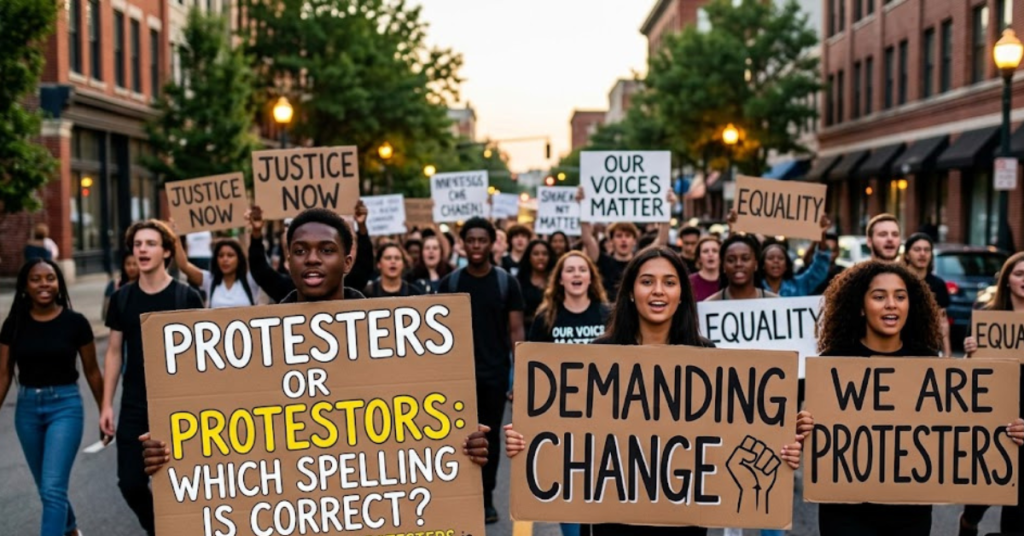

Have you ever paused while writing and wondered whether it should be protestors or protesters? You’re not alone. This small spelling difference causes confusion for students, writers, journalists, and even professionals.
The good news is that both words exist—but one is far more commonly accepted in standard English. Understanding the difference between protestors or protesters helps improve your writing accuracy and makes your content sound more polished and professional.
In this article, we’ll break down the meanings, explain which version is preferred, and show you how to use each one correctly.
Understanding Protestors or Protesters
At first glance, protestors and protesters look like simple spelling variations. However, English usage tends to favor one over the other.
The Most Commonly Accepted Form: Protesters
The word protesters is the standard and widely preferred spelling in modern English.
It refers to:
- People who publicly express opposition
- Individuals participating in demonstrations
- Activists involved in rallies or marches
Example:
- Thousands of protesters gathered outside the parliament building.
This spelling appears more frequently in:
- News reports
- Academic writing
- Legal documents
- Journalism
- Formal essays
Because of its widespread acceptance, protesters is usually the safer and more professional choice.
Is “Protestors” Also Correct?
Yes, protestors is technically a valid word, but it is much less common.
It may appear in some dictionaries and writing styles, especially in older texts or regional usage. However, most modern editors and style guides strongly prefer protesters.
Example:
- Several protestors were seen holding signs near the courthouse.
Even though this sentence is understandable, many readers may see it as less standard.
Why Do People Get Confused?
The confusion often comes from other similar English words.
For example:
- actor
- creator
- translator
- educator
These words naturally end in -or, so many people assume protestor should follow the same pattern.
But English is full of exceptions.
Words like:
- writer
- speaker
- teacher
- driver
use -er, and protester belongs more naturally in this group.
Protestors vs Protesters: Quick Comparison
| Feature | Protesters | Protestors |
| Common usage | Very common | Rare |
| Preferred in formal writing | Yes | Usually no |
| Accepted by dictionaries | Yes | Sometimes |
| Recommended for SEO/content writing | Yes | No |
If you’re choosing between protestors or protesters, go with protesters in most cases.
Grammar Rules Behind the Word
Why “Protester” Sounds More Natural
The noun comes from the verb protest.
In English, people performing an action often take the -er ending:
- teach → teacher
- write → writer
- speak → speaker
- protest → protester
This is why protester feels more grammatically natural.
When Should You Use Protestors?
There are only a few situations where protestors may be acceptable:
1. Quoting Original Text
If a source uses “protestors,” you should preserve the original wording.
2. Specific Regional Preferences
Some regions or publications may still use it.
3. Personal Style Choices
Some writers simply prefer the visual style of “protestor,” though this is less common.
Still, for clarity and consistency, protesters is the stronger option.
Examples in Real-Life Writing
Let’s compare both versions.
Preferred Usage
- Climate protesters marched through the city center.
- Student protesters demanded policy changes.
- Peaceful protesters carried banners and chanted slogans.
Less Common Usage
- Local protestors gathered outside the mayor’s office.
- The article described the protestors as peaceful.
The meaning stays the same, but the first group sounds more natural and standard.
you should almost always choose protesters.
Why?
Because:
- It matches user search intent better
- It aligns with Google’s language preference
- It improves readability and trust
- It looks more polished to readers
Even though people search for protestors or protesters, most authoritative content uses protesters.
Common Related Terms
To better understand the topic, here are some related words:
- demonstrators
- activists
- marchers
- picketers
- dissenters
- campaigners
- civil rights advocates
These are often used interchangeably depending on context.
Common Mistakes to Avoid
1: Assuming Both Are Equally Common
They are not. Protesters is significantly more common.
2: Using Protestors in Formal Writing
This may appear less professional unless required by context.
3: Ignoring Style Consistency
If you choose one version, stay consistent throughout the article.
FAQs About Protestors or Protesters
Is protesters the correct spelling?
Yes, protesters is the standard and preferred spelling in modern English.
Is protestors wrong?
Not exactly. Protestors is not entirely incorrect, but it is much less common and usually avoided in formal writing.
Which spelling should I use in essays?
Use protesters. It is the safer and more widely accepted choice for academic and professional writing.
Do dictionaries include protestor?
Some dictionaries list protestor, but most style guides still recommend protester.
Why do some news articles use protestors?
It may be due to editorial preference, older style guides, or regional language habits.
Conclusion
When deciding between protestors or protesters, the best choice for most situations is clear: protesters.
While both forms exist, protesters is the standard spelling used in journalism, education, business writing, and everyday communication. It feels more natural, looks more professional, and aligns better with modern English grammar.
If your goal is strong writing and better SEO performance, stick with protesters.
Language details like this may seem small, but they make a big difference in clarity and credibility. Keep learning these subtle grammar distinctions, and your writing will stand out for all the right reasons.