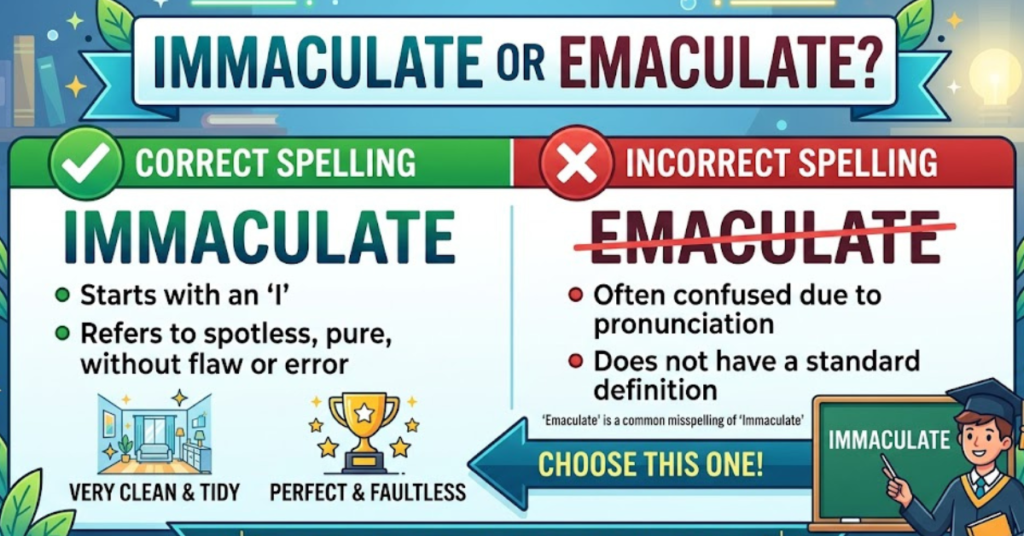

Have you ever paused mid-sentence wondering whether it’s immaculate or emaculate? You’re not alone. This is one of those English spelling confusions that trips up even confident writers. The correct form is immaculate, but the misspelling emaculate is surprisingly common online and in casual writing.
In this guide, we’ll break down the correct spelling, meaning, origin, and how to avoid this mistake in the future. If you’ve ever second-guessed this word, this article will clear it up once and for all.
What Does “Immaculate” Mean?
The word immaculate is used to describe something that is extremely clean, perfect, or free from flaws.
Common meanings include:
- Perfectly clean or spotless
- Free from errors or mistakes
- Flawless in appearance or condition
Examples in sentences:
- The kitchen was immaculate after cleaning.
- She gave an immaculate presentation with no mistakes.
- His record is immaculate, with no losses.
In short, immaculate represents perfection in cleanliness or performance.
Immaculate or Emaculate: Which Is Correct?
Let’s settle the confusion clearly:
Correct spelling: Immaculate
Incorrect spelling: Emaculate
The word “emaculate” is not recognized in standard English dictionaries. It is simply a common spelling error.
Why do people make this mistake?
There are a few reasons:
- Mishearing the word when spoken
- Dropping the first “i” sound in pronunciation
- Typing quickly without checking spelling
- Influence of similar-sounding words
Remember: English often uses silent or less-emphasized vowel sounds, which leads to confusion.
Origin of the Word “Immaculate”
The word immaculate comes from the Latin word immaculatus, which means “unstained” or “spotless.”
Breakdown:
- in- = not
- maculatus = stained or spotted
So literally, it means “not stained.”
This origin explains why the word is strongly associated with purity and perfection.
How to Use “Immaculate” Correctly
Using immaculate properly depends on context. It works in both literal and figurative situations.
Literal usage:
- Immaculate clothing
- Immaculate rooms
- Immaculate surfaces
Figurative usage:
- Immaculate timing
- Immaculate performance
- Immaculate strategy
Quick tip:
If something looks flawless or perfectly done, “immaculate” is the right word.
Common Related Words LSI Keywords
To better understand and use the term, here are related words often associated with it:
- Spotless
- Perfect
- Flawless
- Pristine
- Clean
- Unblemished
- Faultless
These terms can sometimes be used interchangeably depending on context.
Why Spelling Matters in SEO and Writing
If you’re writing online content, spelling accuracy matters more than ever. Using incorrect forms like “emaculate” can:
- Reduce search visibility
- Hurt credibility
- Confuse readers
Search engines understand correct spelling better, so using immaculate consistently improves content quality and ranking potential.
FAQs About Immaculate or Emaculate
1. Is “emaculate” a real word?
No, “emaculate” is not a correct English word. The correct spelling is “immaculate.”
2. What does immaculate mean in simple words?
It means perfectly clean, flawless, or without mistakes.
3. Why do people spell immaculate as emaculate?
Mostly due to pronunciation confusion and typing errors.
4. Can immaculate be used for people?
Yes, it can describe appearance, behavior, or performance that is flawless.
5. Is immaculate a positive word?
Yes, it is always used in a positive sense.
Conclusion
The confusion between immaculate or emaculate is common, but the correct spelling is always immaculate. It’s a powerful word used to describe perfection, cleanliness, and flawless execution.
Whether you’re writing professionally or casually, using the correct spelling improves clarity and credibility. Now that you know the difference, you won’t fall into this common language trap again.