

Ever found yourself wondering “gage or gauge — which spelling is correct?” You’re not alone. The confusion around gage or gauge is surprisingly common, especially when writing about measurements, interest levels, or technical instruments. While both spellings exist, they aren’t always interchangeable, and using the wrong one can make your writing look less polished.
In this guide, we’ll break down is it gage or gauge, explain when each spelling is appropriate, and provide real-world examples such as pressure gage or gauge and gage or gauge interest. By the end, you’ll know exactly which one to use with confidence.
Is It Gage or Gauge? The Quick Answer
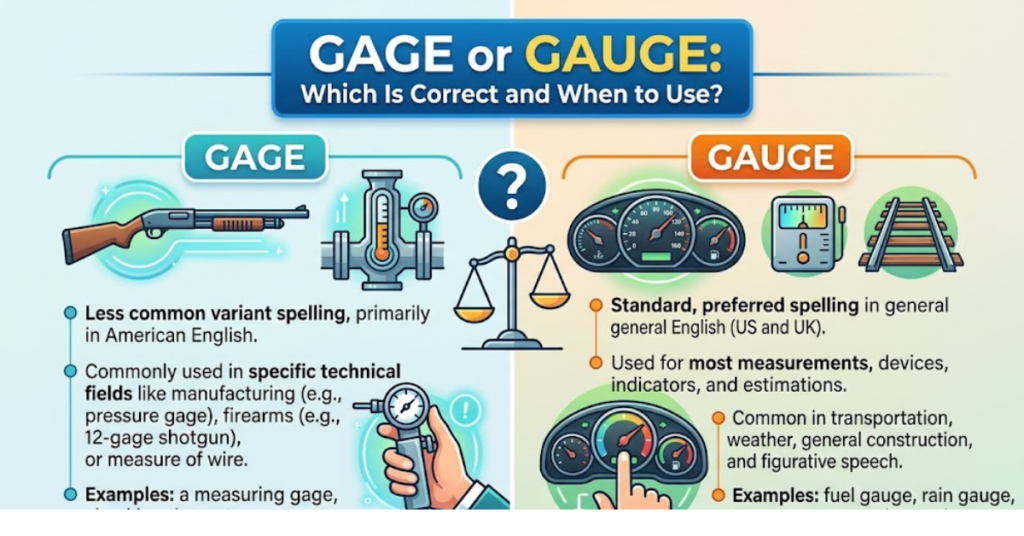
The short answer: “Gauge” is the preferred and most widely accepted spelling, especially in modern English.
However:
- Gauge → Standard spelling used in most contexts
- Gage → Less common, often appears in specialized or brand-specific usage
In most writing — academic, professional, or online — “gauge” is the safer choice.
What Does “Gauge” Mean?
The word gauge has several meanings depending on context:
As a Verb
To gauge means to measure, estimate, or evaluate something.
Examples:
- She tried to gauge his reaction.
- It’s hard to gauge interest before launching a product.
- The manager gauged customer demand.
This is why phrases like “gage or gauge interest” typically use gauge interest.
As a Noun
Gauge can also refer to a measuring device.
Examples:
- Fuel gauge
- Temperature gauge
- Tire pressure gauge
This leads to another common question: pressure gage or gauge?
The correct and preferred form is pressure gauge.
When Is “Gage” Used?
The spelling gage is considered an alternative or archaic form. It appears in:
- Some company names (e.g., Gage Products)
- Legal or historical contexts
- Certain technical documentation (rare)
In modern everyday writing, gage is usually avoided unless it’s part of a proper noun.
Gage or Gauge Interest: Which Is Correct?
The correct phrase is gauge interest.
Why? Because gauge means to estimate or measure — exactly what you’re doing when you try to determine someone’s interest level.
Correct examples:
- We sent a survey to gauge interest.
- The company gauged customer demand.
Incorrect in most cases:
- We sent a survey to gage interest.
Pressure Gage or Gauge: Technical Usage
In technical and engineering fields, you may occasionally see pressure gage, but pressure gauge is overwhelmingly preferred.
Correct examples:
- Check the tire pressure gauge.
- The pressure gauge showed a drop.
Even in manuals and professional documents, gauge is the industry standard.
Why Does the Confusion Exist?
The confusion between gage or gauge comes from historical spelling variations. Over time, English standardized gauge, but gage lingered in certain niches.
Today:
- Dictionaries list gage as a variant
- Most style guides recommend gauge
- Search engines strongly favor gauge
Quick Comparison: Gage vs Gauge
| Feature | Gauge | Gage |
| Modern standard spelling | Yes | No |
| Used in measuring tools | Yes | Rare |
| Used in “gauge interest” | Yes | No |
| Common in professional writing | Yes | No |
| Acceptable alternative | Yes | Limited |
Tips to Remember the Difference
- Use gauge for measurements
- Use gauge when estimating something
- Use gage only in special cases or names
- When unsure, always choose gauge
A simple rule: Gauge is almost always correct.
FAQs About Gage or Gauge
1. Is it gage or gauge?
Gauge is the correct and standard spelling in most situations.
2. Should I write gauge interest or gages interest?
The correct phrase is gauges interest.
3. Is pressure gagess wrong?
Not technically wrong, but pressure gauges is the preferred and widely accepted spelling.
4. Why do some companies use “gage”?
Some brands use gages for stylistic or historical reasons.
5. Are gage and gauge interchangeable?
Not always. Gauge works everywhere, but gages is limited.
Conclusion
When deciding between gage or gauge, the safest and most professional choice is gauge. Whether you’re trying to gauge interest, checking a pressure gauge, or simply writing clearly, sticking with gauge ensures accuracy and consistency.
Understanding is it gage or gauge helps improve your writing, boosts credibility, and avoids confusion. When in doubt, remember: Gauge is the modern standard.
Want to sharpen your grammar skills even further? Explore more language guides and keep refining your writing one word at a time.