

Have you ever met a Spanish speaker and wanted to ask where they’re from but didn’t know the right words? Learning where are you from in Spanish is one of the most useful conversation starters for travel, school, work, or making new friends.
Spanish is spoken in more than 20 countries, and asking someone about their origin is a natural way to connect. In this guide, you’ll learn how to say where are you from in Spanish, understand the difference between formal and informal phrases, hear pronunciation tips, and discover how native speakers actually use these expressions in real conversations.
How to Say “Where Are You From” in Spanish
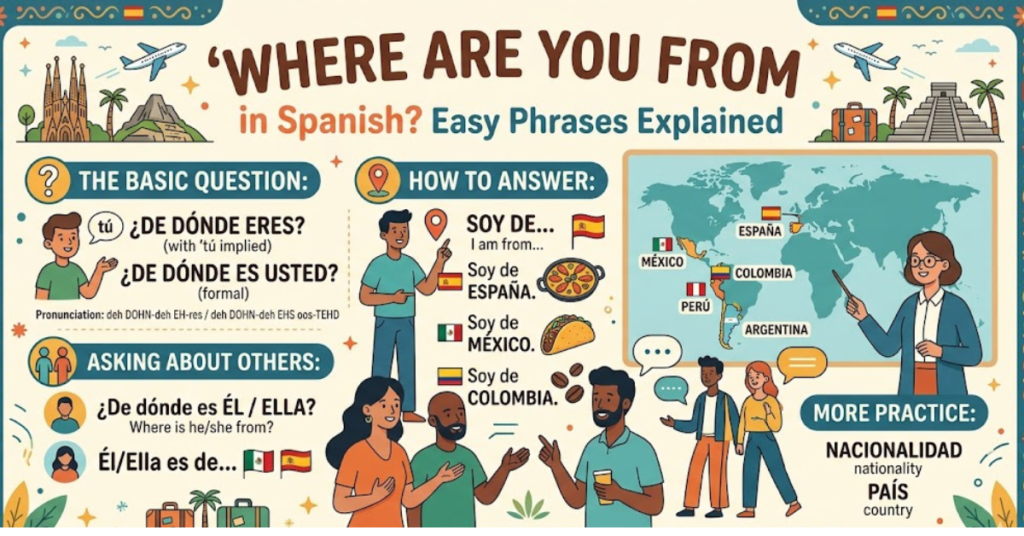
The most common translation of “where are you from” in Spanish is:
¿De dónde eres?
Pronunciation: deh DON-deh EH-rehs
Meaning: Where are you from? (informal)
This phrase is widely used in everyday conversations with friends, classmates, or people around your age.
Example:
- ¿De dónde eres?
Where are you from? - Soy de México.
I’m from Mexico.
This is the phrase most Spanish learners start with because it’s simple, natural, and commonly understood across Spanish-speaking countries.
Where Are You From in Spanish Formal
If you’re speaking to someone older, a stranger, a teacher, or someone in a professional setting, use the formal version:
¿De dónde es usted?
Meaning: Where are you from? (formal)
Spanish has formal and informal speech patterns, and using the correct version shows politeness and respect.
Example:
- ¿De dónde es usted?
Where are you from? - Soy de España.
I’m from Spain.
When to Use the Formal Version
Use formal Spanish when speaking to:
- Employers or coworkers
- Elderly people
- Customers or clients
- Teachers or professors
- People you’ve just met in professional situations
Where Are You From in Spanish Informal
The informal version is:
¿De dónde eres?
This is used with:
- Friends
- Family members
- Children
- People your age
- Casual social interactions
In many Spanish-speaking cultures, informal language creates a friendly and relaxed tone.
How Do You Say Where Are You From in Spanish?
If you’re wondering how do you say where are you from in Spanish, the answer depends on the level of formality.
Here’s a quick comparison:
| English Phrase | Spanish Translation | Usage |
| Where are you from? | ¿De dónde eres? | Informal |
| Where are you from? | ¿De dónde es usted? | Formal |
Both phrases are correct. The difference lies in who you’re talking to.
Understanding the Grammar Behind the Phrase
To truly master Spanish conversation, it helps to understand the structure.
Breaking Down “¿De dónde eres?”
- De = from
- Dónde = where
- Eres = you are
Literally, it means:
“From where are you?”
Spanish sentence structure sometimes differs from English, but once you learn the pattern, it becomes easier to form similar questions.
Common Responses to “Where Are You From?” in Spanish
After asking someone where they’re from, you’ll probably hear responses like these:
Basic Responses
- Soy de Estados Unidos.
I’m from the United States. - Soy de Argentina.
I’m from Argentina. - Soy de Colombia.
I’m from Colombia.
Other Natural Replies
- Vengo de Perú.
I come from Peru. - Nací en Chile.
I was born in Chile. - Mi familia es de Cuba.
My family is from Cuba.
Learning both the question and the response helps you carry on a smoother conversation.
Pronunciation Tips for Beginners
Spanish pronunciation is often easier than English because words are pronounced more consistently.
Pronouncing “¿De dónde eres?”
Try saying it slowly:
Deh DON-deh EH-rehs
Helpful tips:
- The “r” in eres is soft.
- Stress the first syllable in dónde.
- Keep vowels short and clear.
Listening to native speakers through language apps or videos can improve your accent quickly.
Alternative Ways to Ask Where Someone Is From
Spanish speakers sometimes use different expressions depending on the region or situation.
1. ¿Cuál es tu nacionalidad?
What is your nationality?
More formal and less common in casual conversations.
2. ¿De qué país eres?
What country are you from?
Very clear and beginner-friendly.
3. ¿Dónde naciste?
Where were you born?
This asks about birthplace rather than current identity.
Why This Phrase Is Important in Spanish Conversations
Knowing how to say where are you from in Spanish helps you:
- Start conversations naturally
- Connect with native speakers
- Travel more confidently
- Practice speaking skills
- Learn about different cultures
It’s one of the first phrases taught in Spanish classes because it opens the door to meaningful interaction.
Common Mistakes to Avoid
Many beginners make small errors when learning this phrase.
Incorrect:
- Dónde eres?
Correct:
- ¿De dónde eres?
The word “de” is essential because the sentence literally means “from where are you?”
Another Common Mistake:
Using formal Spanish with close friends can sound distant, while using informal speech in professional settings may sound rude.
Quick Practice Examples
Here are a few mini-dialogues to help you practice.
Casual Conversation
Ana: ¿De dónde eres?
Luis: Soy de México.
Formal Conversation
Empleado: ¿De dónde es usted?
Cliente: Soy de Colombia.
Travel Situation
Turista: ¿De qué país eres?
Persona local: Soy de Perú.
Practicing out loud helps improve fluency and confidence.
Cultural Notes About Spanish-Speaking Countries
Spanish is spoken differently across regions, but the phrase ¿De dónde eres? is understood almost everywhere.
Countries where Spanish is the primary language include:
- Spain
- Mexico
- Argentina
- Colombia
- Chile
- Peru
- Cuba
- Dominican Republic
Although accents vary, this phrase remains universally recognized.
Best Ways to Remember the Phrase
Want to memorize it faster? Try these methods:
Use Flashcards
Write:
- Front: Where are you from?
- Back: ¿De dónde eres?
Practice Daily
Ask yourself:
- ¿De dónde soy?
- Soy de…
Watch Spanish Content
Movies, YouTube videos, and podcasts help reinforce natural pronunciation.
FAQs
How do you say “where are you from” in Spanish?
The most common way is ¿De dónde eres? for informal situations and ¿De dónde es usted? for formal situations.
What is the informal version of “where are you from” in Spanish?
The informal version is ¿De dónde eres?
What is the formal version of “where are you from” in Spanish?
The formal version is ¿De dónde es usted?
Is “¿De qué país eres?” correct?
Yes. It means “What country are you from?” and is commonly used.
How do Spanish speakers usually respond?
Most people reply with:
- Soy de + country/city
Example:
Soy de España.
Is this phrase used in all Spanish-speaking countries?
Yes. While accents differ, the phrase is understood across the Spanish-speaking world.
Conclusion
Learning where are you from in Spanish is one of the easiest and most practical steps toward speaking Spanish naturally. Whether you use the informal ¿De dónde eres? or the formal ¿De dónde es usted?, this simple question can lead to meaningful conversations and cultural connections.
Now that you know how to say where are you from in Spanish, practice it in real conversations, language apps, or with Spanish-speaking friends. The more you use it, the more confident you’ll become.