

Ever looked at your clock and wondered why the time suddenly feels “off”? That’s daylight saving time at work. If you’re asking “when does time change 2026,” you’re not alone—millions of people search for these key dates every year.
In this guide, you’ll find the exact 2026 time change schedule, how daylight saving time (DST) works, and practical tips to adjust smoothly. Whether you’re planning travel, managing work schedules, or just trying to avoid being late, this article has you covered.
When Does Time Change 2026? Key Dates
In countries that observe daylight saving time, clocks change twice a year—once in spring and once in autumn.
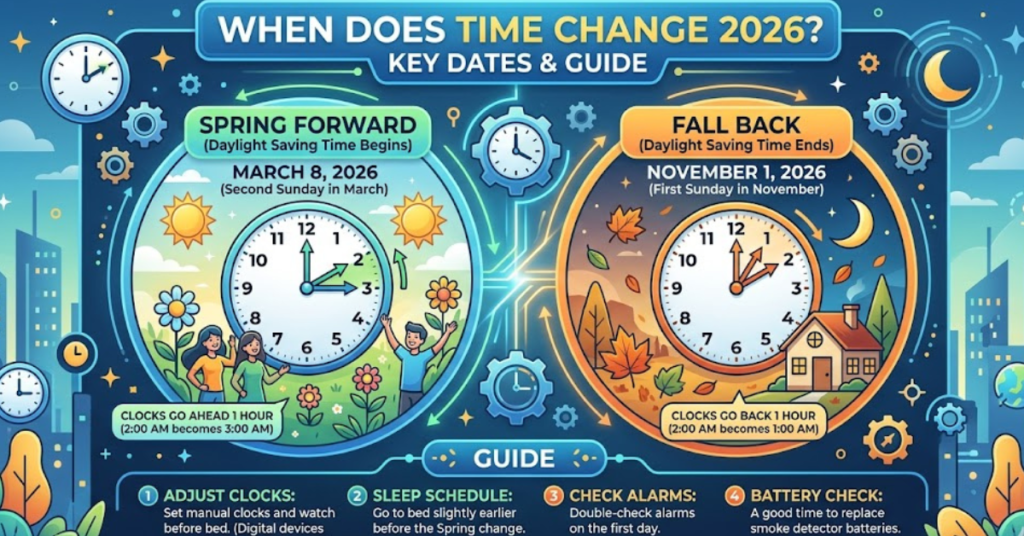
Daylight Saving Time Starts Spring Forward
- Date: Sunday, March 8, 2026
- Time Change: Clocks move forward 1 hour at 2:00 AM → 3:00 AM
- What It Means: You lose one hour of sleep but gain more daylight in the evening.
Daylight Saving Time Ends Fall Back
- Date: Sunday, November 1, 2026
- Time Change: Clocks move back 1 hour at 2:00 AM → 1:00 AM
- What It Means: You gain an extra hour of sleep but evenings get darker sooner.
What Is Daylight Saving Time?
Daylight saving time is the practice of adjusting clocks to make better use of daylight during warmer months. Instead of wasting sunlight early in the morning, DST shifts it to the evening hours.
Why It Exists:
- To save energy by reducing artificial lighting
- To extend evening daylight for outdoor activities
- To support economic productivity in some sectors
Which Countries Change Time in 2026?
Not every country follows daylight saving time. Here’s a quick breakdown:
Countries That Observe DST:
- United States
- Canada
- United Kingdom
- European Union countries
- Australia (partially)
Countries That Do NOT Change Time:
- Pakistan
- India
- China
- Japan
- Most countries near the equator
If you’re in Pakistan, you won’t need to adjust your clocks in 2026—but it’s still useful to know these dates when dealing with international calls or travel.
How to Prepare for Time Change 2026
Adjusting to a time change can feel surprisingly difficult. Here are some simple ways to make it easier:
1. Shift Your Sleep Schedule Gradually
Start going to bed 15–20 minutes earlier (or later) a few days before the change.
2. Use Natural Light
Expose yourself to sunlight in the morning to help reset your internal clock.
3. Avoid Caffeine Late in the Day
Especially during the transition period, caffeine can disrupt your sleep cycle.
4. Update Your Devices
Most smartphones update automatically, but double-check manual clocks like:
- Wall clocks
- Car dashboards
- Kitchen appliances
Common Problems During Time Changes
Even though it’s just one hour, DST can affect your body more than expected.
Possible Effects:
- Sleep disruption
- Reduced concentration
- Temporary fatigue
- Mood changes
These usually fade within a few days as your body adapts.
Benefits and Criticism of Daylight Saving Time
Benefits:
- Longer daylight hours in the evening
- Potential energy savings
- More time for outdoor activities
Criticism:
- Disrupts sleep patterns
- Minimal modern energy savings
- Confusing for global coordination
In fact, some regions are considering eliminating DST altogether.
FAQs About When Does Time Change 2026
1. When does time change in 2026 in the USA?
Time changes on March 8, 2026 (spring forward) and November 1, 2026 (fall back).
2. Do all countries change time in 2026?
No, many countries—including Pakistan—do not observe daylight saving time.
3. Why do clocks change at 2:00 AM?
This time minimizes disruption to daily activities, as most people are asleep.
4. Will daylight saving time be abolished soon?
Some countries are debating it, but as of 2026, most still follow DST rules.
5. Do smartphones update automatically?
Yes, most modern devices adjust automatically if connected to the internet.
Conclusion
So, when does time change 2026? The key dates are March 8 and November 1 in countries that observe daylight saving time. While not every country follows DST, understanding these changes can help you stay organized—especially when dealing with global schedules.
Take a few minutes to prepare ahead of time, and the shift will feel much smoother. If you frequently travel or work across time zones, keeping track of DST dates is more than helpful—it’s essential.