
If you’ve ever paused mid-sentence wondering whether to use your vs you’re, you’re not alone. This is one of the most common English grammar mix-ups—even native speakers slip up.
The confusion between your vs you’re often shows up in texts, captions, and even professional writing. But once you understand the difference, it becomes surprisingly easy to get right every time.
In this guide, you’ll learn the meaning, usage, and real-life examples of your vs you’re, plus why phrases like your vs you’re welcome and your vs you’re meme are so popular online.
Your vs You’re Explained The Simple Difference
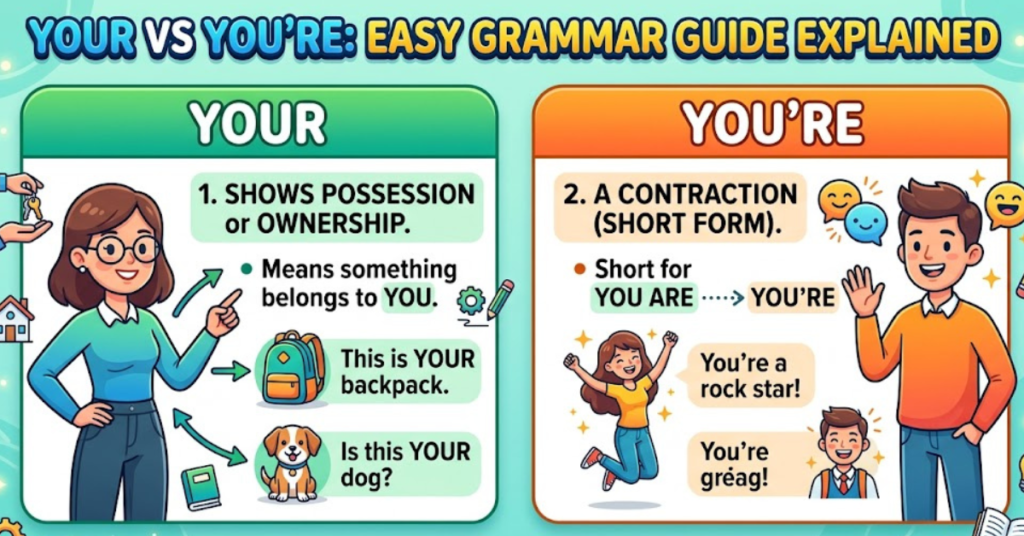
At the core, the difference is actually very simple:
- Your = possession (something belongs to you)
- You’re = contraction of you are
Let’s break it down further.
What Does “Your” Mean?
Your is a possessive adjective. It shows ownership or belonging.
Examples:
- Is this your phone?
- I like your shoes.
- Where is your bag?
If you can replace it with “my” or “his,” then your is correct.
What Does “You’re” Mean?
You’re is short for “you are.”
Examples:
- You’re amazing. (You are amazing)
- You’re going to love this movie.
- I think you’re right.
A quick test: if you can replace it with “you are,” then you’re is the correct choice.
Common Mistakes with Your vs You’re
Even though the rule is simple, mistakes happen often in casual writing.
Most common errors:
- Your welcome
You’re welcome - Your doing great
You’re doing great - I like you’re idea
I like your idea
These mistakes are especially common in texting and social media posts.
Your vs You’re Welcome: Why People Get Confused
The phrase your vs you’re welcome is one of the most searched grammar doubts online.
The correct expression is:
You’re welcome (You are welcome)
Saying “your welcome” changes the meaning completely and becomes grammatically incorrect.
Think of it this way:
- “You’re welcome” = You are welcome (correct response)
- “Your welcome” = sounds like you’re talking about someone’s “welcome” (incorrect)
Your vs You’re Meme: Internet Humor Explained
The internet has turned your vs you’re meme into a running joke—and for good reason.
Memes often exaggerate grammar mistakes like:
- “If your reading this, your wrong”
- “You’re vs your is not that hard”
Why these memes work:
- They highlight a very common mistake
- They’re instantly relatable
- They mix humor with learning
While funny, these memes actually help reinforce the correct usage of your vs you’re through repetition.
Quick Tricks to Remember Your vs You’re
Here are simple memory hacks that actually work:
1. The “You Are” Test
Replace the word with “you are”:
- If it works → you’re
- If it doesn’t → your
2. Possession Rule
If something belongs to someone → use your
3. Apostrophe Reminder
The apostrophe in you’re always signals a missing letter (you are → you’re)
Why Your vs You’re Matters in Writing
Using your vs you’re correctly is more than grammar—it affects clarity and credibility.
Correct usage helps:
- Improve professional writing
- Make social media posts clearer
- Avoid misunderstandings
- Build better communication skills
Even small mistakes can change how your message is perceived.
FAQs About Your vs You’re
1. What is the difference between your vs you’re?
“Your” shows possession, while “you’re” means “you are.”
2. Is “your welcome” correct?
No, the correct form is “you’re welcome.”
3. Why do people confuse your vs you’re?
Because they sound identical when spoken, making spelling the only difference.
4. What is your vs you’re meme about?
It’s a humorous internet trend highlighting common grammar mistakes.
5. How can I never confuse your vs you’re again?
Use the “you are” replacement trick—if it fits, use “you’re.”
Conclusion: Mastering Your vs You’re Easily
Understanding your vs you’re is one of the simplest ways to instantly improve your writing. The key is remembering that your = possession and you’re = you are.
Whether you’re writing a message, posting online, or reacting with “your vs you’re welcome,” getting it right makes your communication clearer and more professional. And while your vs you’re meme content keeps the topic fun online, the rule itself is straightforward once you practice it.
Master this small grammar rule, and your writing instantly becomes sharper and more confident.