
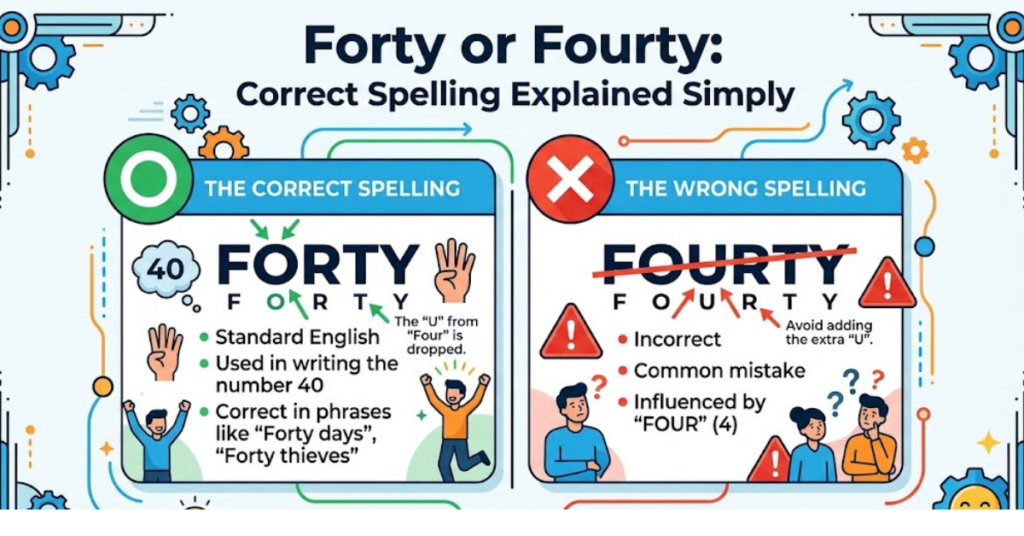

If you’ve ever paused while writing and wondered “forty or fourty—what’s correct?”, you’re definitely not alone. This small spelling confusion trips up students, professionals, and even native English speakers more often than you’d think.
The correct spelling is forty, not fourty. In this article, we’ll break down why that’s the case, how to remember it easily, and how to use it correctly in everyday writing—whether you’re writing numbers in words, filling out a cheque, or typing “40 dollars.”
Let’s clear up the confusion once and for all.
Forty or Fourty – Which Is Correct?
The correct form is:
Forty
Fourty (incorrect)
So if you’re asking “is it forty or fourty?”, the answer is always forty.
Even though the number 4 is spelled “four,” the word changes when forming “forty.” English often has these irregular spelling patterns, and this is one of them.
Why Is It Spelled Forty and Not Fourty?
The confusion comes from how we form numbers in English. You might expect it to follow a pattern like:
- Four → Fourteen → Fourty
But English doesn’t work that neatly. The correct historical spelling dropped the “u,” evolving into:
- Four → Forty
This is due to linguistic simplification over time. English often shortens or modifies older spellings for easier pronunciation and consistency.
How to Spell Forty or Fourty Correctly
If you’re unsure how to spell forty or fourty, just remember:
- The correct spelling is forty
- There is no “u” after “four” in this case
Quick memory trick:
Think of it as:
“Four becomes forty—but loses the U.”
This simple trick helps avoid the most common spelling mistake.
Forty or Fourty in Cheque Writing
When writing amounts in words, especially on a cheque, accuracy matters.
Correct examples:
- Forty dollars only
- Forty rupees only
- Forty pounds only
Incorrect:
- Fourty dollars only
So if you’re writing forty or fourty in cheque, always use forty to avoid banking issues or rejection.
Forty or Fourty Dollars – Common Usage
People often search “forty or fourty dollars” when writing payments, invoices, or online transactions.
Here’s the correct usage:
- “I owe you forty dollars.”
- “The item costs forty dollars.”
- “Payment of forty dollars received.”
Always remember: numbers under 100 are usually spelled out in formal writing, and accuracy matters in financial contexts.
40 – Forty or Fourty?
Another common search is “40 forty or fourty”.
Here’s the rule:
- 40 = forty
- Never use “fourty”
So:
- 40 = forty
- 40 = fourty
Simple, clean, and always correct.
Why People Still Write “Fourty”
Even though it’s incorrect, “fourty” appears frequently due to:
- Influence of the word “four”
- Auto-correction mistakes
- Informal writing habits
- Lack of awareness of irregular spelling rules
But in formal writing, exams, business documents, and digital content, forty is always the correct spelling.
How Do You Spell Forty or Fourty? (Easy Guide)
If you’re still unsure, here’s the simplest way to remember:
Correct:
- Forty
Incorrect:
- Fourty
Rule of thumb:
If you’re writing the number 40 in words, always drop the “u.”
FAQs About Forty or Fourty
1. Is it forty or fourty?
The correct spelling is forty.
2. Why is forty not spelled fourty?
It’s due to historical changes in English spelling, where the “u” was dropped over time.
3. How do you spell 40 in words?
40 is spelled forty.
4. Is fourty ever correct?
No, “fourty” is always considered incorrect in modern English.
5. What is correct: forty or fourty dollars?
The correct phrase is forty dollars.
6. How to avoid spelling mistakes like forty or fourty?
Practice common number spellings and remember irregular forms like:
- four → forty (not fourty)
Conclusion: Forty or Fourty Made Simple
The confusion between forty or fourty is common, but the rule is straightforward: forty is the correct spelling in all contexts.
Whether you’re writing numbers in words, filling out a cheque, or using “40” in formal documents, always stick with forty. Avoiding this small mistake can make your writing more professional and accurate.
If you want to improve your English spelling further, focusing on irregular number forms like this is a great place to start.