
It’s one of those tiny spelling doubts that can slow you down mid-sentence: “is it meant or ment?” If you’ve ever hesitated while typing, you’re definitely not alone. The confusion around meant or ment is common because the words sound identical when spoken.
In this article, we’ll break down the correct spelling, explain the grammar behind it, and show you how to use it confidently in everyday writing.
Meant or Ment: Which Is Correct?
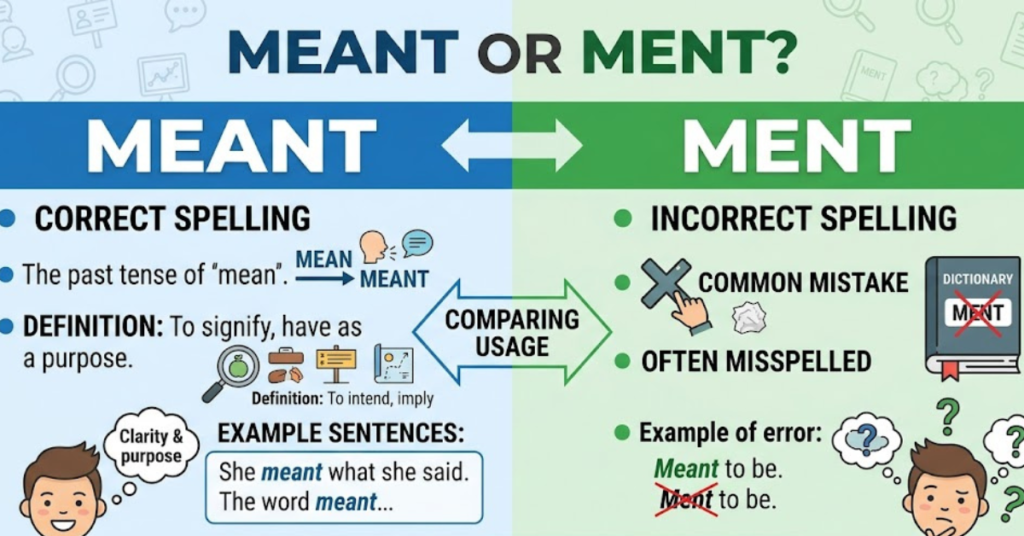
Let’s clear things up right away: “meant” is the correct spelling, while “ment” is not a valid standalone word in standard English.
If you’re asking, is it meant or ment, the answer is always “meant” when you’re referring to the past tense of “mean.”
Example:
- Correct: I meant what I said.
- Incorrect: I ment what I said.
What Does “Meant” Mean?
To understand meant or ment meaning, it helps to look at the correct word.
“Meant” is the past tense and past participle of the verb “mean.” It can have several related meanings:
Common meanings:
- Intended to express or say something
- Signified or represented something
- Had a particular purpose or importance
Examples:
- She meant to call you earlier.
- This gift meant a lot to me.
Why “Ment” Is Incorrect
You might wonder why “ment” shows up so often if it’s wrong.
Here’s why:
- It sounds exactly like “meant” in spoken English
- Many English words end in “-ment” (like “development” or “agreement”)
- Typing quickly can lead to dropped letters
However, “ment” by itself isn’t a correct spelling for this verb form.
Meant or Ment Grammar Explained
Understanding meant or ment grammar is actually quite simple once you know the verb pattern.
Verb forms of “mean”:
- Present: mean
- Past: meant
- Past participle: meant
Unlike regular verbs, “mean” is irregular, so it doesn’t follow the usual “-ed” pattern.
How to Spell Meant or Ment Correctly
If you often pause and think, how to spell meant or ment, here’s a quick trick:
Break it down:
- “Mean” + “t” = Meant
Easy memory tip:
Think of “meant” as “mean” with a “t” at the end.
Meant or Ment in a Sentence
Using the word in context helps reinforce the correct form.
Examples:
- I didn’t mean to upset you, but I meant what I said.
- He meant to finish the work on time.
- What she said meant more than you realize.
If you try replacing “meant” with “ment,” the sentence immediately looks incorrect.
Common Mistakes to Avoid
When dealing with meant or ment spelling, here are a few pitfalls to watch for:
- Dropping the “a” and writing “ment”
- Confusing it with words ending in “-ment”
- Skipping proofreading in quick messages
Even small spelling errors can affect clarity, especially in formal writing.
Quick Recap: Meant or Ment
If you’re still wondering, is it meant or ment?, here’s the simple answer:
- “Meant” is correct
- “Ment” is incorrect
- Always use “meant” as the past form of “mean”
Tips to Remember the Correct Usage
Here are a few practical ways to avoid confusion:
- Always connect it back to the word “mean”
- Add a “t” at the end → “meant”
- Practice using it in everyday sentences
Consistency will make the correct spelling feel natural over time.
Read also <<< “How Hard Is the Bar Exam? Real Pass Rates & Tips“
FAQs
Is it meant or ments?
The correct spelling is “meant.” “Ment” is not a valid word in this context.
What does meant mean?
“Meant” is the past tense of “mean,” meaning intended, expressed, or signified.
How do you spell meant or ments?
The correct spelling is “meant,” with an “a.”
Is ments ever correct?
“Ment” only appears as part of longer words like “payment” or “agreement,” not as a standalone word.
How can I remember meant or ments spelling?
Think of “mean” and simply add a “t” to form “meant.”
Conclusion
The confusion between meant or ment is easy to understand, but the solution is straightforward. “Meant” is the correct spelling, and it follows the irregular verb pattern of “mean.”
Once you remember that “meant” comes directly from “mean,” you’ll never have to second-guess yourself again. Keep practicing, stay consistent, and your writing will become clearer and more confident with every sentence.