
It’s one of those tricky English questions that catches people off guard: lieing or lying—which one is correct?
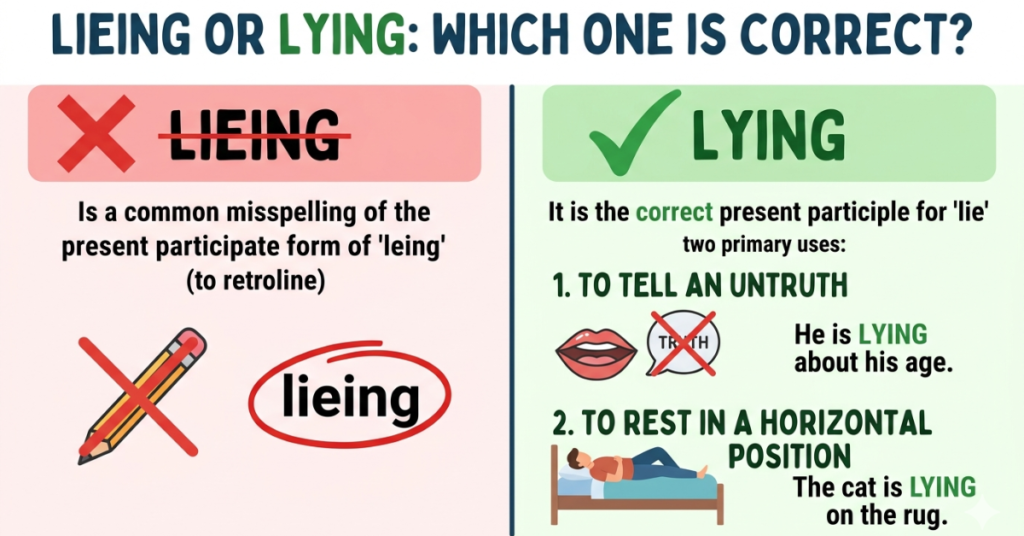
Let’s settle it right away. The correct spelling is “lying.” The form “lieing” is incorrect and not used in standard English. But the reason why it’s spelled this way is where things get interesting—and useful.
Lieing or Lying: Which Is Correct?
If you’re asking is it lieing or lying, the answer is clear:
Correct:
- lying
Incorrect:
- lieing
So, lieing or lying which is correct? Always choose lying.
Why “Lying” Is the Correct Spelling
English spelling rules can be confusing, especially with verbs ending in “-ie.”
The rule:
When a verb ends in -ie, you:
- Change -ie → y
- Then add -ing
Example:
- lie → lying (not lieing)
This same rule applies to:
- die → dying
- tie → tying
So if you’re wondering how do you spell both words, just remember this simple pattern.
Lieing or Lying Meaning Explained
Now let’s talk about meaning, because “lying” actually has two different uses.
1. Lying (not telling the truth)
- Example: “He is lying about what happened.”
2. Lying (resting or reclining)
- Example: “She is lying in bed.”
So when people search both of these meaning, they’re often dealing with these two contexts.
Lieing or Lying Down vs Lying About Something
The same word works in different situations.
Lying down (resting):
- “I’m lying down after a long day.”
Lying (not telling the truth):
- “He keeps lying to his friends.”
Context tells you which meaning is intended.
Common Examples of Lying in Sentences
Here are some simple examples (correct usage included):
- “The dog is lying on the floor.”
- “She admitted she was lying.”
- “He’s lying in bed watching TV.”
- “Stop lying and tell the truth.”
Notice how “lying” works naturally in both meanings.
Why People Mistakenly Write “Lieing”
If “lying” is correct, why do people still write “lieing”?
Common reasons:
- Misunderstanding spelling rules
- Assuming “-ing” just gets added directly
- Influence of similar-looking words
So if you’ve ever typed it wrong, you’re definitely not alone.
Lieing or Lying in UK vs US English
The rule doesn’t change.
In all English variants:
- British English
- American English
- Australian English
“Lying” is always the correct spelling.
Quick Grammar Tip: Lie vs Lay
While we’re here, let’s clear up another common confusion.
Lie (no object):
- “I lie down to rest.”
Lay (needs an object):
- “I lay the book on the table.”
Present continuous:
- lie → lying
- lay → laying
This helps avoid mixing up similar verbs.
Spelling Cheat Sheet
If you’re still unsure about the spelling of words, here’s a quick reminder:
- lie → lying
- die → dying
- tie → tying
- lie → lieing (incorrect)
FAQs About Lieing or Lying
1. Is it lieing or lying?
The correct spelling is lying.
2. Why is “lieing” incorrect?
Because verbs ending in “-ie” change to “-y” before adding “-ing.”
3. Does “lying” mean resting or not telling the truth?
It can mean both—context determines the meaning.
4. How do you spell lieing or lying correctly?
Always spell it lying.
5. Is “lying” correct in UK English?
Yes, it’s correct in all forms of English.
Final Thoughts: Keep It Simple and Remember the Rule
So, lieing or lying—what’s the final answer? It’s always “lying.” Once you remember the simple “-ie to -y” rule, this confusion disappears for good.
English spelling can feel tricky, but small patterns like this make a big difference. The next time you write it, you’ll know exactly what to do—no second guessing needed.
Want to improve your grammar even more? Keep exploring these small but powerful rules—they add up quickly.