
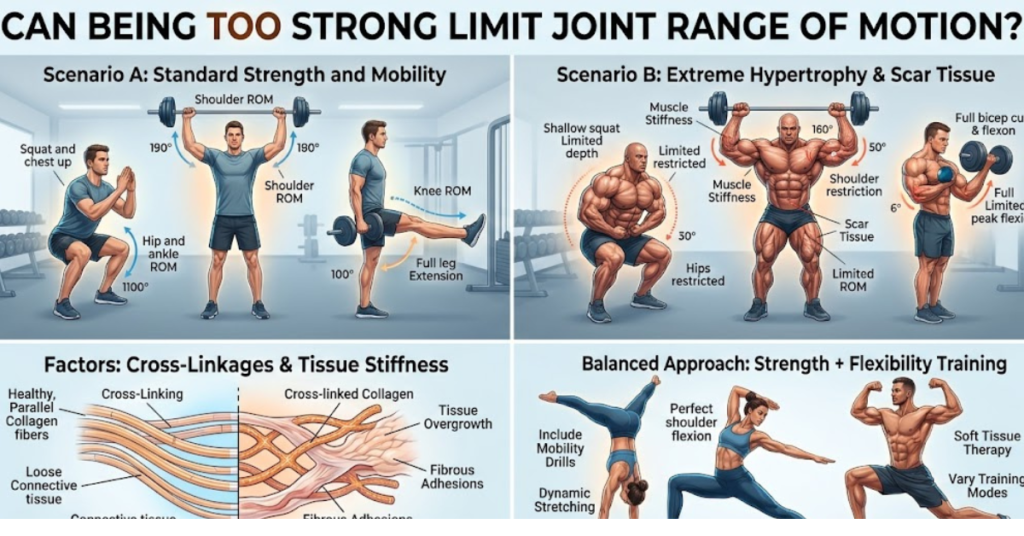

Can strength actually become a limitation? It sounds counterintuitive, but how might being too strong actually restrict a joint’s range of motion? This question comes up often among athletes, gym-goers, and even physical therapy patients. While building muscle is generally beneficial, excessive strength—especially when not paired with flexibility and mobility work—can reduce how freely a joint moves.
In this article, we’ll explore how muscle tightness, imbalances, and neuromuscular adaptations can limit mobility, and what you can do to maintain both strength and flexibility. Let’s break down the science in simple, practical terms.
How Might Being Too Strong Actually Restrict a Joint’s Range of Motion?
When muscles become very strong, they can also become shortened, stiff, or dominant, which limits joint mobility. This usually happens when strength training focuses on contraction without equal attention to stretching or full-range movement.
Here are the main ways this occurs:
- Muscle hypertrophy reduces space around joints
- Increased muscle stiffness limits stretch
- Opposing muscle imbalance develops
- Protective neural tension restricts movement
- Reduced connective tissue elasticity
These factors together can make joints feel “tight” even though the muscles are powerful.
Muscle Tightness and Reduced Flexibility
One of the most common explanations for how being too strong restricts range of motion is muscle tightness. When you repeatedly train muscles in a shortened position, they adapt by staying shorter.
For example:
- Heavy bench pressing → tight chest and shoulders
- Squats without mobility work → tight hips
- Bicep curls → limited elbow extension
Over time, this tightness reduces the joint’s ability to move freely, which may increase injury risk.
Strength Imbalances Between Opposing Muscles
Joints rely on balanced strength between opposing muscle groups. When one side becomes significantly stronger, it can pull the joint into a restricted position.
Common Examples
- Strong quadriceps + weak hamstrings → limited knee mobility
- Dominant hip flexors → reduced hip extension
- Strong internal rotators → restricted shoulder rotation
These imbalances create mechanical resistance, which limits full joint movement.
Increased Muscle Density and Joint Compression
As muscles grow larger and denser, they can physically limit how far a joint can travel. This is particularly noticeable in bodybuilders.
For example:
- Large biceps may restrict elbow flexion
- Thick calves may limit ankle dorsiflexion
- Bulky shoulders may reduce overhead reach
This isn’t harmful by itself, but it can reduce functional mobility if not managed.
Neural Protective Mechanisms
Your nervous system also plays a role. When muscles become extremely strong but not flexible, the brain may limit range of motion to prevent injury.
This protective response:
- Prevents overstretching tight muscles
- Reduces instability
- Limits unfamiliar movement patterns
In short, your body is saying, “We’re strong here, but not safe beyond this range.”
Connective Tissue Stiffness
Strength training increases tendon and ligament stiffness, which improves force transfer but may reduce elasticity.
This leads to:
- Less “give” in joints
- Reduced shock absorption
- Limited extreme ranges of motion
That’s why athletes who focus only on strength sometimes struggle with deep squats, overhead mobility, or rotation.
Signs Your Strength Is Limiting Mobility
You might be experiencing this if you notice:
- Difficulty reaching overhead
- Tight hips during squats
- Reduced shoulder rotation
- Feeling “strong but stiff”
- Limited flexibility despite regular workouts
These are common indicators that being too strong may be restricting joint range of motion.
How to Balance Strength and Mobility
The good news? You don’t have to sacrifice strength to regain flexibility. The key is balanced training.
1. Train Through Full Range of Motion
Avoid partial reps when possible. Full-range exercises maintain mobility.
Examples:
- Deep squats
- Full overhead presses
- Controlled lunges
2. Add Mobility Work
Include:
- Dynamic stretching before workouts
- Static stretching after workouts
- Mobility drills for tight areas
3. Strengthen Opposing Muscles
Balance your training:
- Push vs. pull
- Quads vs. hamstrings
- Chest vs. upper back
4. Use Soft Tissue Techniques
Helpful methods include:
- Foam rolling
- Massage
- Mobility balls
- Active release techniques
These improve tissue quality and range.
5. Include Functional Movement Training
Exercises like:
- Yoga
- Pilates
- Mobility flows
- Controlled articular rotations (CARs)
These help maintain joint freedom.
Why Mobility Matters Even If You’re Strong
Strength without mobility can lead to:
- Poor movement mechanics
- Increased injury risk
- Reduced athletic performance
- Joint discomfort
- Limited functional ability
True fitness means being strong AND mobile, not just powerful.
FAQs
Can too much muscle reduce flexibility?
Yes. Large or tight muscles can physically limit joint movement, especially without regular stretching.
Do bodybuilders have reduced range of motion?
Sometimes. Muscle size and stiffness can restrict movement if mobility work is neglected.
Is strength training bad for flexibility?
No. Strength training actually improves flexibility when performed through a full range of motion.
How often should I stretch to avoid stiffness?
Aim for 3–5 mobility sessions per week, even if they’re short (5–10 minutes).
Can tight muscles cause joint pain?
Yes. Tight muscles pull joints out of alignment and increase stress, which may lead to discomfort.
Conclusion
So, how might being too strong actually restrict a joint’s range of motion? The answer lies in muscle tightness, imbalances, increased stiffness, and neural protective mechanisms. While strength is valuable, it must be paired with flexibility and mobility to maintain healthy, functional joints.
The takeaway is simple: train strong, move freely, and balance both.
Add mobility work, stretch regularly, and focus on full-range exercises to keep your joints healthy.