
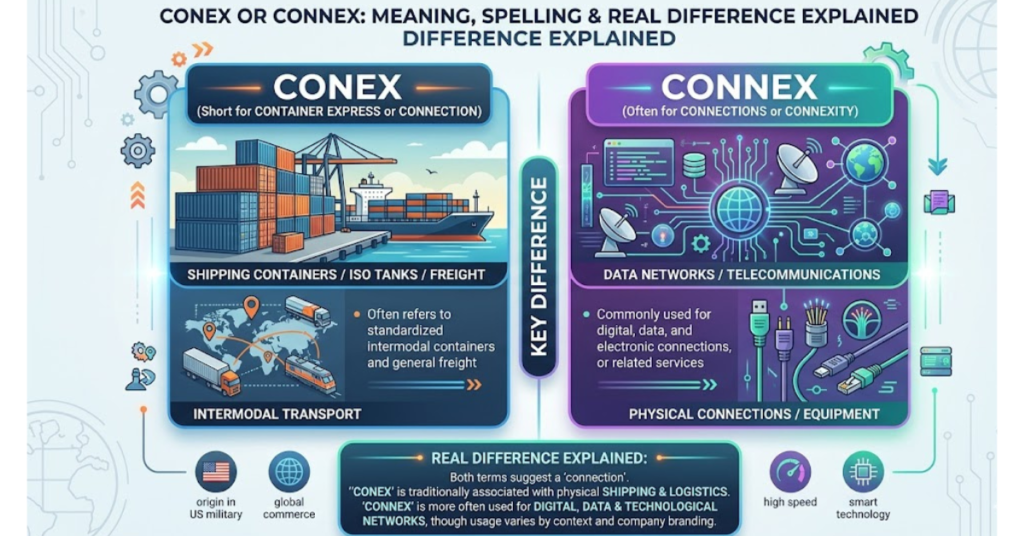

If you’ve ever searched for conex or connex, you’re not alone. This is one of those confusing keyword pairings that pops up in shipping, logistics, and storage conversations all the time.
The term conex or connex usually refers to large steel containers used for transport or storage, but the spelling often creates confusion. Is it “CONEX,” “Connex,” or are both correct?
In this article, we’ll break it down clearly so you understand where the term comes from, what it means, and how it’s used in real-world industries like shipping, military logistics, and portable storage.
What Does Conex or Connex Mean?
The correct and historically accurate term is CONEX, short for Container Express. It refers to standardized steel shipping containers used primarily by the military and later adopted widely in commercial logistics.
However, the variation “connex” has emerged over time as a common misspelling or informal adaptation of the word.
Key takeaway:
- CONEX = Correct and official term
- Connex = Informal spelling or typo
Both usually point to the same idea: a durable, transportable storage container.
The Origin of CONEX Containers
To understand conex or connex, it helps to look at where CONEX actually came from.
Military Roots
The CONEX box was introduced by the U.S. Army in the 1950s during the Korean War. The goal was simple:
- Speed up supply transport
- Protect goods from damage
- Standardize cargo handling
These containers became the foundation for modern shipping containers used worldwide today.
Evolution into Modern Shipping Containers
Over time, CONEX boxes evolved into:
- ISO shipping containers
- Cargo containers used in global trade
- Modular storage units for businesses and homes
Conex vs Connex: Why the Confusion Exists
The confusion around conex or connex comes from a few simple reasons:
1. Pronunciation
People often hear “conex” and assume it’s spelled “connex” due to similar phonetics.
2. Brand Influence
Some companies use “Connex” as a brand name for storage or modular units, reinforcing the alternate spelling.
3. Internet Search Habits
Search engines often group both terms together because users frequently mix them.
Common Uses of CONEX Containers Today
Whether you call it conex or connex, the concept is widely used in several industries.
1. Shipping and Logistics
- International cargo transport
- Freight storage
- Port handling systems
2. Military Operations
- Field supply storage
- Mobile equipment transport
- Temporary housing units
3. Construction & Storage
- On-site tool storage
- Portable offices
- Emergency shelters
Types of CONEX Containers
Modern CONEX-style containers come in different forms:
- Standard Dry Containers – Used for general cargo
- High Cube Containers – Extra height for bulky goods
- Refrigerated Containers (Reefers) – Temperature-controlled transport
- Modified Storage Units – Offices, homes, or workshops
Why CONEX Containers Are Still Important
Even decades after their invention, CONEX containers remain essential because they offer:
- High durability (steel construction)
- Weather resistance
- Easy transportability
- Stackable design for efficiency
- Cost-effective storage solutions
This is why the term conex or connex still shows up in searches today.
- CONEX container
- CONEX box
- shipping container storage
- military cargo container
- modular storage unit
Using these related terms helps improve relevance without keyword stuffing.
Frequently Asked Questions FAQs
1. What is the correct spelling: conex or connex?
The correct spelling is CONEX, though “connex” is commonly used informally or as a misspelling.
2. What does CONEX stand for?
CONEX stands for Container Express, originally developed for military logistics.
3. Are connex containers different from conex containers?
No, they generally refer to the same type of container. “Connex” is just a variation in spelling.
4. What are CONEX boxes used for today?
They are used for shipping, storage, construction sites, and even modular housing.
5. Is CONEX still used in the military?
Yes, though modern standardized ISO containers have largely replaced older CONEX designs.
Conclusion
When it comes to conex or connex, the truth is simple: the correct term is CONEX, but both versions point to the same idea of a strong, reusable shipping container.
From military logistics to global trade and modern storage solutions, CONEX containers have played a major role in shaping how goods are transported and stored efficiently.
If you’re researching storage or shipping solutions, understanding this term helps you make more informed decisions—and avoids confusion in technical or commercial discussions.