

Ever paused mid-sentence wondering whether it’s “flies away” or “flys away”? You’re not alone. This small spelling detail trips up many English learners and even native speakers. The good news is that once you understand the rule behind it, you’ll never second-guess yourself again.
In this article, we’ll break down the correct usage of flies away or flys away, explain why one form is right, and give you practical examples you can use in everyday writing.
Flies Away or Flys Away: The Correct Form
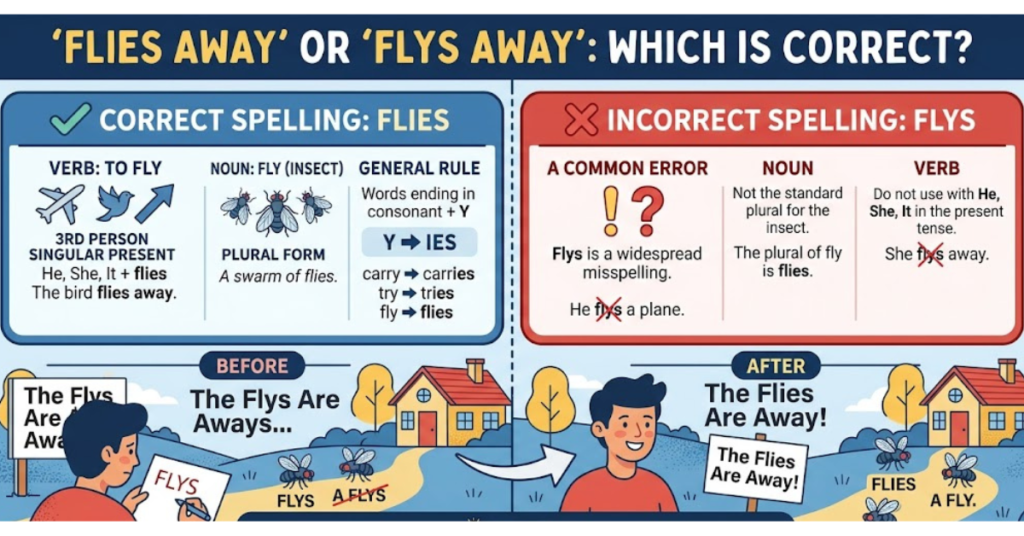
Let’s settle it clearly: “flies away” is correct, while “flys away” is incorrect in standard English.
Why “Flies Away” Is Correct
The verb fly follows a common spelling rule when forming the third-person singular (he, she, it):
- When a verb ends in a consonant + “y”, the “y” changes to “ies”
- Example:
- fly → flies
- cry → cries
- try → tries
So, the correct phrase is:
The bird flies away.
Why “Flys Away” Is Incorrect
“Flys” breaks the standard spelling rule for verbs ending in “y.” While you might see it occasionally online, it’s considered a grammatical error in formal and informal writing alike.
Important Note
There is a rare exception:
- “flys” can appear as a noun in specialized contexts (like fishing, referring to artificial flies).
- However, it is not correct as a verb form.
Examples of “Flies Away” in Sentences
Using the correct phrase in context helps solidify your understanding:
- The butterfly flies away when approached.
- He watches as the plane flies away into the clouds.
- Time flies away when you’re having fun.
- The bird quickly flies away from danger.
Each example follows the correct third-person singular verb form.
Common Grammar Rule Behind It
Understanding this rule will help you avoid similar mistakes:
Verbs Ending in “Y”
When forming the present simple tense:
- Consonant + y → ies
- fly → flies
- carry → carries
- Vowel + y → just add “s”
- play → plays
- stay → stays
This distinction is key when deciding between flies away or flys away.
Related Mistakes to Avoid
Writers often confuse similar verb forms. Here are a few to watch out for:
- flys → flies
- crys → cries
- trys → tries
Keeping this pattern in mind can instantly improve your writing accuracy.
Quick Memory Tip
If you’re unsure, remember this simple trick:
“If ‘fly’ meets ‘he/she/it,’ the ‘y’ becomes ‘ies.’”
So:
- He flies away
- She flies away
When to Use “Fly Away” Instead
Sometimes, you might not need “flies” at all.
Use “fly away” when:
- You’re using the base form of the verb
- The subject is plural or first/second person
Examples:
- Birds fly away in winter.
- I wish I could fly away.
FAQs
1. Is “flys away” ever correct?
No, flys away is not correct as a verb form. The correct phrase is always flies away.
2. Why does “fly” become “flies”?
Because of the grammar rule where verbs ending in a consonant + “y” change “y” to “ies” in third-person singular.
3. Can I use “fly away” instead of “flies away”?
Yes, but only when the subject is plural or not third-person singular (e.g., “they fly away”).
4. Is this rule the same for all verbs ending in “y”?
Mostly yes. If there’s a consonant before “y,” change it to “ies.” If there’s a vowel, just add “s.”
5. Why do people still write “flys away”?
It’s usually due to confusion or lack of familiarity with the spelling rule.
Conclusion
To wrap it up, the debate over flies away or flys away has a clear answer: “flies away” is the correct and grammatically sound choice. Understanding the simple “y to ies” rule not only solves this confusion but also helps you avoid similar mistakes in English.
If you want to sharpen your grammar further, keep practicing with real sentences and pay attention to common verb patterns. Small improvements like this can make your writing clearer, more professional, and more confident.