
The confusion between emasculate vs demasculate is more common than you might think. Many people use both words interchangeably, but in reality, only one of them is widely accepted in standard English. The focus keyword emasculate vs demasculate often appears in searches because learners want to understand whether both words are correct or if one is simply a mistake.
In this guide, we’ll break down the meaning of emasculate, explain the truth about demasculate, and show you how to use the correct term confidently in writing and speech.
What Does “Emasculate” Mean?
The word emasculate is a legitimate English term with clear meanings. It is most often used in two contexts:
1. Literal Meaning (Biological/Medical)
Historically, emasculate means to remove male reproductive organs. This usage is rare in everyday conversation and mostly appears in medical or historical contexts.
2. Figurative Meaning (Most Common Today)
In modern usage, emasculate usually means:
- To weaken a man’s sense of masculinity
- To make someone feel less powerful or confident
- To undermine authority or strength
Example:
- The constant criticism made him feel emasculated at work.
Is “Demasculate” a Real Word?
Here’s where most confusion begins in the emasculate vs demasculate debate.
The short answer:
“Demasculate” is not a standard English word.
It is often used mistakenly by speakers who assume “de-” can be added for emphasis, but dictionaries do not recognize it as correct usage.
Why people use it:
- Mishearing the word emasculate
- Trying to create an opposite form
- Influence from informal speech or internet usage
Important takeaway:
- Emasculate = correct word
- Demasculate = incorrect / nonstandard usage
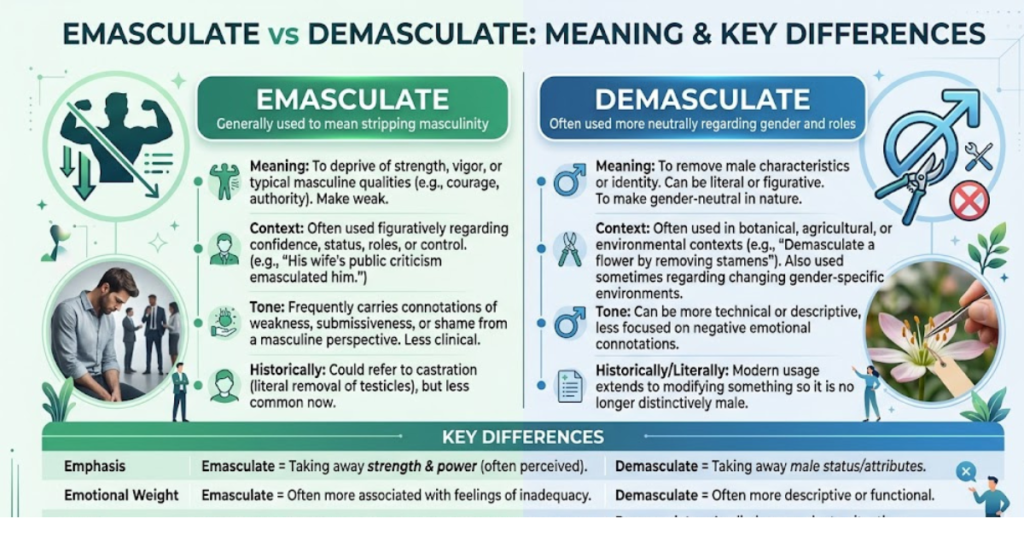
Emasculate vs Demasculate: Key Differences
Let’s simplify the comparison:
| Term | Status | Meaning | Usage |
| Emasculate | Correct word | To weaken or reduce strength/masculinity | Formal & informal English |
| Demasculate | Incorrect word | No official meaning | Avoid in writing |
The key point in emasculate vs demasculate is that only emasculate belongs in proper English vocabulary.
Common Contexts Where “Emasculate” Is Used
Understanding usage helps avoid mistakes. Here are the most common situations:
1. Workplace or Authority
- A manager may feel emasculated if ignored by their team.
2. Relationships
- Sometimes used to describe emotional dynamics in relationships (though often controversial).
3. Literature and Media
- Frequently used in books, films, and discussions about identity or power.
Why the Confusion Exists
The confusion around emasculate vs demasculate usually comes from language patterns:
- The prefix “de-” often means removal (like defrost, deactivate)
- People assume “demasculate” should logically mean the opposite of emasculate
- But English doesn’t always follow logical word-building rules
So even though it sounds right, it’s linguistically incorrect.
How to Use “Emasculate” Correctly
To avoid mistakes, follow these simple tips:
- Use it in emotional or power-related contexts
- Don’t invent “demasculate” as a counterpart
- Stick to standard dictionaries and formal writing rules
Correct:
- The policy made employees feel emasculated.
Incorrect:
- The policy demasculated employees.
FAQs: Emasculate vs Demasculate
1. Is “demasculate” a real word?
No, demasculate is not recognized in standard English dictionaries.
2. What does emasculate mean in simple words?
It means to weaken someone’s confidence, power, or masculinity.
3. Can emasculate be used for women?
Yes, but it is more commonly used in reference to men or masculinity.
4. What is the opposite of emasculate?
There is no direct single-word opposite, but terms like empower or strengthen are often used.
5. Why do people say demasculate?
It’s usually a mistake based on assumption or misunderstanding of word formation.
Conclusion
The debate around emasculate vs demasculate is actually simpler than it seems. Only emasculate is a correct and recognized English word, while demasculate is a common but incorrect variation that should be avoided in formal writing.
If you want to improve your language accuracy, sticking to verified dictionary meanings is always the safest approach. Understanding subtle differences like this not only improves your vocabulary but also makes your writing more professional and confident.