
If you’ve ever paused while writing and wondered whether it should be in front or infront, you’re not alone. This is one of those small but surprisingly common English confusion points that trips up both beginners and fluent speakers.
The focus keyword in front or infront mainly comes down to one simple rule: spacing matters. In standard English, only one form is correct—and understanding why helps you avoid a frequent spelling mistake in writing, emails, exams, and online content.
Let’s break it down clearly and practically.
In Front or Infront: What’s the Difference?
The key difference is actually very simple:
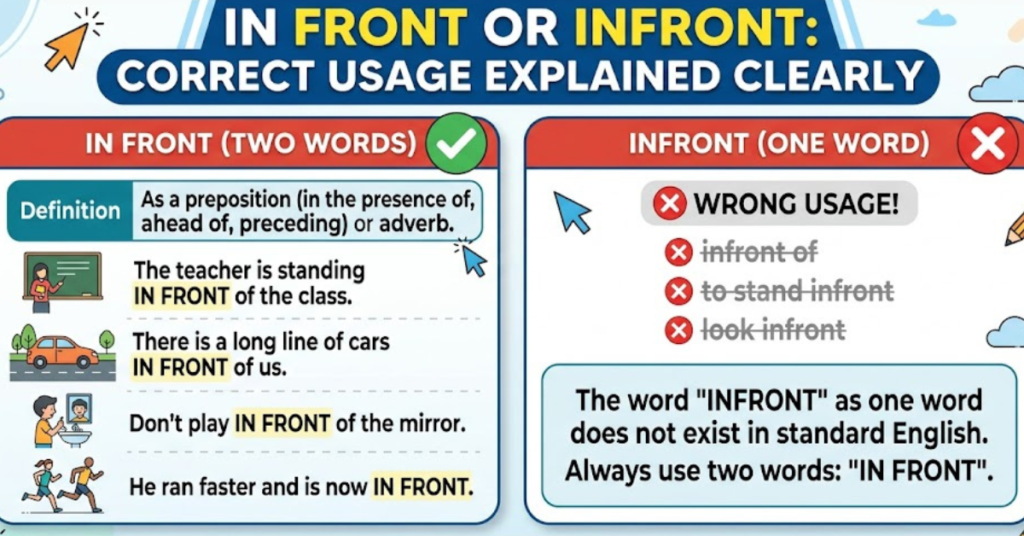
- “In front” (correct form) → a prepositional phrase
- “Infront” (incorrect form) → not accepted in standard English
Why “in front” is correct
“In front” is made of two words:
- In (preposition)
- Front (noun)
Together, they describe the position of something ahead of another object.
For example:
- The car is parked in front of the house.
There is no recognized single-word version in standard English dictionaries.
Is “Infront” Ever Correct?
No, “infront” is not correct in formal English.
It is commonly seen in:
- Social media posts
- Informal texting
- Typing errors
However, it is not accepted in:
- Academic writing
- Professional communication
- English exams
Why people still use “infront”
People often write “infront” because:
- It sounds like one word when spoken
- Fast typing leads to missed spacing
- Influence from informal online writing
But in proper grammar, it should always be separated.
How to Use “In Front” Correctly With Examples
Understanding usage is easier with real examples.
Basic usage
- She stood in front of the mirror.
- The bus stopped in front of the school.
- There is a garden in front of our house.
More natural sentences
- He placed the book in front of me.
- Don’t speak loudly in front of guests.
- The cat is sleeping in front of the door.
These examples show how “in front of” always works with the preposition “of” when describing position.
Common Mistakes with “In Front or Infront”
Many learners repeat the same errors when using this phrase.
Mistake 1: Writing “infront”
The dog is sitting infront the gate
The dog is sitting in front of the gate
Mistake 2: Missing “of”
She stood in front the teacher
She stood in front of the teacher
Mistake 3: Overusing it in informal writing
Even though it’s a simple phrase, using it correctly improves clarity and professionalism.
Quick Grammar Tips to Remember
Here are some easy ways to avoid mistakes:
- Always remember: in front = two words
- If you’re unsure, think: “in the front of”
- Use “of” after “in front”
- Avoid merging words in formal writing
A simple trick: if you can separate the meaning, it should stay separate in writing.
Why Correct Usage Matters in Writing
Using the correct form of in front or infront isn’t just about grammar rules—it affects how polished your writing looks.
Correct usage helps you:
- Improve academic scores
- Make professional emails clearer
- Build better SEO content quality
- Avoid basic writing mistakes
Search engines also favor correctly written content because it improves readability.
FAQs: In Front or Infront
1. Which is correct: in front or infront?
“In front” is correct. “Infront” is a common spelling mistake.
2. Is “infront” accepted in English dictionaries?
No, standard dictionaries do not recognize “infront” as correct usage.
3. What is the meaning of in front?
It means something is positioned ahead of another object or person.
4. Can I ever write “infront” in informal chat?
While people may use it in texting, it is still considered incorrect grammar.
5. Is “in front of” always needed?
Yes, when describing position, “in front of” is the correct full phrase.
Conclusion
When it comes to in front or infront, the rule is simple: only “in front” is correct English. The incorrect form “infront” is a common spelling mistake caused by fast typing and informal usage.
By remembering that “in front” is always written as two separate words and usually followed by “of,” you can avoid one of the most frequent grammar errors in English writing.
If you want cleaner, more professional writing, start by fixing small details like this—they make a bigger difference than you might think.