
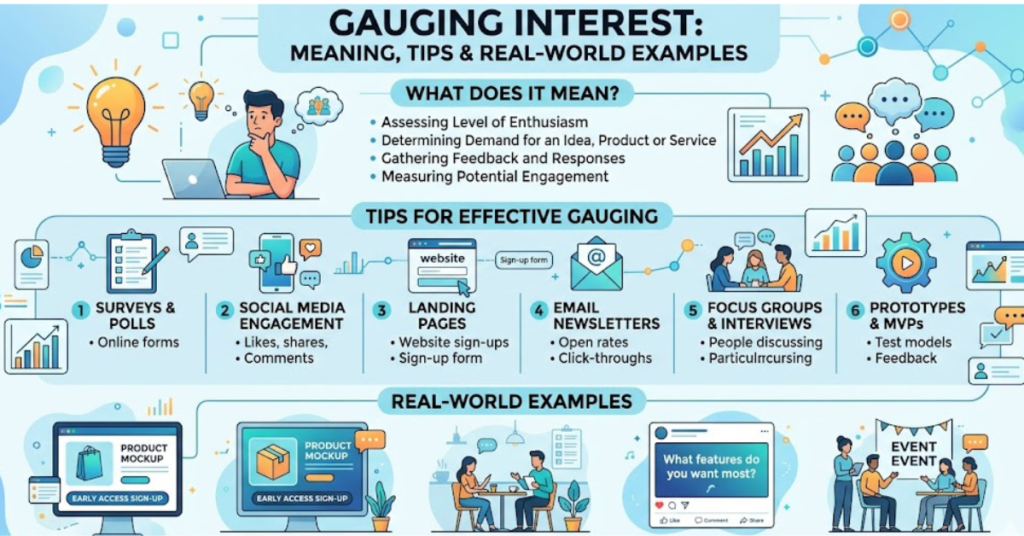

Ever wondered how businesses know whether people actually care about an idea before launching it? That’s where gauging interest comes in. Whether you’re testing a new product, planning an event, or simply exploring a conversation topic, gauging interest helps you understand how engaged or willing people are.
In simple terms, gauging interest means measuring or estimating how much attention, enthusiasm, or willingness someone has toward something. This article breaks down the gauging interest meaning, why it matters, and practical ways to do it effectively.
What Is Gauging Interest? Definition & Meaning
Gauging interest refers to the process of assessing how interested someone or a group of people are in a particular idea, product, service, or opportunity.
Gauging Interest Meaning in Simple Terms
- Measuring curiosity or enthusiasm
- Checking willingness before making a decision
- Testing demand before launching something
- Observing reactions to ideas or proposals
For example:
- A company surveys customers before releasing a new feature.
- A recruiter asks candidates about job flexibility.
- A friend suggests a trip to see if others are excited.
All of these are forms of gauging interest.
Why Gauging Interest Matters
Understanding interest levels can save time, money, and effort. Here’s why it’s important:
- Prevents investing in unwanted ideas
- Helps make data-driven decisions
- Improves communication and collaboration
- Increases chances of success
- Identifies your target audience more clearly
Businesses, marketers, and even individuals use gauging interest to avoid guessing and instead rely on feedback.
Common Ways to Gauge Interest
There are several effective methods to measure interest depending on your goal.
1. Ask Direct Questions
The simplest way is to ask people directly:
- “Would you be interested in this?”
- “How likely are you to try this?”
- “Does this idea appeal to you?”
Direct questions give immediate clarity.
2. Use Surveys and Polls
Online polls are great for quickly measuring interest.
Examples:
- Instagram story polls
- Google Forms surveys
- Email questionnaires
These methods provide measurable insights.
3. Observe Behavior
Sometimes actions speak louder than words. Look for:
- Click-through rates
- Sign-ups
- Event registrations
- Engagement metrics
These indicators show genuine interest.
4. Soft Launch or Test Run
Testing a small version before full release is a smart way to gauge interest:
- Beta releases
- Limited-time offers
- Pilot programs
This reduces risk and provides real feedback.
5. Monitor Social Media Reactions
Comments, shares, and likes can help you understand audience sentiment.
Higher engagement usually means stronger interest.
Examples of Gauging Interest in Real Life
Here are some practical examples:
In Business
A startup announces a product concept and collects pre-orders to gauge interest before production.
In Marketing
Brands test different ad headlines to see which gets more clicks.
In Workplace
Managers ask employees if they’d like flexible working hours.
In Everyday Conversations
Someone says, “I’m thinking of starting a book club — anyone interested?”
Tips for Gauging Interest Effectively
To get accurate results, follow these tips:
- Be clear and specific with your questions
- Avoid leading or biased wording
- Use multiple methods (survey + observation)
- Analyze both positive and negative feedback
- Act on the insights you gather
The goal is to measure genuine interest, not just polite responses.
Signs Someone Is Interested
When gauging interest, look for these indicators:
- Asking follow-up questions
- Showing excitement or enthusiasm
- Taking action (signing up, buying, etc.)
- Responding quickly
- Sharing with others
These signals often indicate strong interest.
Common Mistakes When Gauging Interest
Avoid these pitfalls:
- Asking too many questions
- Ignoring negative feedback
- Assuming silence means interest
- Only asking friends or biased groups
- Not testing with real audiences
Being objective improves accuracy.
FAQs About Gauging Interest
What does gauging interest mean?
Gauging interest means assessing how interested someone is in an idea, product, or opportunity before making a decision.
Why is gauging interest important?
It helps reduce risk, improve decisions, and understand audience demand before investing resources.
How do you gauge interest in a product?
You can use surveys, pre-orders, beta tests, social media engagement, and customer feedback.
Is gauging interest the same as market research?
Not exactly. Gauging interest is often a smaller step, while market research is broader and more detailed.
What is an example of gauging interests?
Posting a poll asking, “Would you buy this?” before launching a product is a common example.
Conclusion
Gauging interest is a powerful yet simple strategy for making smarter decisions. Whether you’re launching a product, planning an event, or starting a conversation, understanding how people feel first can save time and increase success.
By applying techniques like surveys, observation, and test runs, you can confidently move forward knowing there’s real demand. Start small, gather feedback, and refine your approach — that’s the essence of gauging interest done right.