
If you’ve ever typed “aerial vs arial” into Google, you’re not alone. These two words look almost identical, yet they mean completely different things. One relates to things in the air, while the other is a font used in documents and design. Confusing them can lead to awkward mistakes—especially in professional writing or graphic design.
In this guide, we’ll break down aerial vs arial in plain English, with examples, comparisons, and tips so you never mix them up again.
Aerial vs Arial: Quick Comparison
Before diving deeper, here’s a simple side-by-side comparison:
| Word | Meaning | Usage | Example |
| Aerial | Related to the air or sky | Photography, antennas, drones | “The drone captured aerial footage.” |
| Arial | A sans-serif font style | Typography, design, documents | “Use Arial for your resume.” |
The easiest way to remember:
- Aerial = Air
- Arial = Font
What Does “Aerial” Mean?
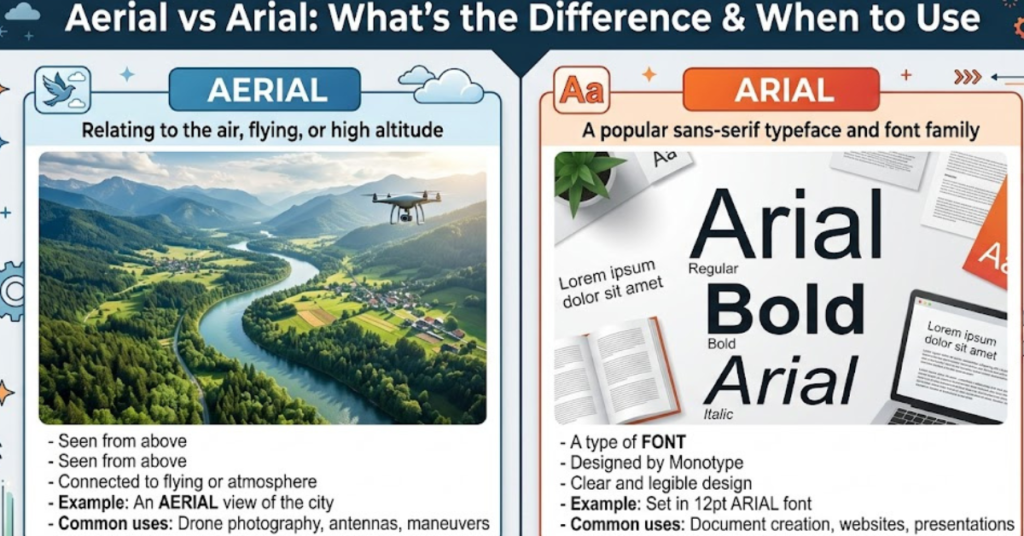
The word aerial refers to anything connected to the air, sky, or elevated view. It’s commonly used in photography, sports, technology, and broadcasting.
Common Uses of Aerial
- Aerial photography – photos taken from above
- Aerial view – bird’s-eye perspective
- Aerial antenna – device that receives signals
- Aerial stunts – acrobatics performed in the air
Example Sentences
- The helicopter captured stunning aerial footage of the coastline.
- We installed an aerial on the roof for better TV reception.
- The gymnast performed an incredible aerial flip.
Notice how every example relates to height, air, or elevation.
What Does “Arial” Mean?
Arial is a sans-serif typeface created in 1982. It’s widely used in documents, websites, and presentations because it’s clean and easy to read.
Why Arial Is Popular
- Simple and professional appearance
- Easy readability on screens
- Default font in many programs
- Works well for resumes and business documents
Example Sentences
- Please format the report in Arial, size 12.
- The website uses Arial for body text.
- My resume looks cleaner in Arial than Times New Roman.
Here, Arial always refers to typography, not anything related to air.
Aerial vs Arial: How to Remember the Difference
A quick memory trick can save you from mistakes:
- Aerial → Contains “air” → Think sky or height
- Arial → Ends like “trial” → Think text/font
You can also remember:
If you can see it in the sky, it’s aerial.
If you see it in a document, it’s Arial.
Common Mistakes People Make
Here are a few examples of incorrect vs correct usage:
Incorrect: Please use aerial font for your resume.
Correct: Please use Arial font for your resume.
Incorrect: The drone captured Arial photos.
Correct: The drone captured aerial photos.
These small errors can make writing look unprofessional, so it’s worth double-checking.
When Should You Use Aerial?
Use aerial when talking about:
- Drones or helicopters
- Views from above
- Antennas or signals
- Acrobatics in the air
- Maps or satellite imagery
When Should You Use Arial?
Use Arial when referring to:
- Fonts in documents
- Graphic design typography
- Website text styling
- Resume formatting
- Presentation slides
FAQs About Aerial vs Arial
1. Is Arial a correct spelling?
Yes, Arial is correct when referring to the font. It’s not related to air or height.
2. Is aerial related to photography?
Yes, aerial photography means photos taken from above, often using drones or aircraft.
3. Why do people confuse aerial vs arial?
They sound similar and differ by only one letter, making them easy to mix up.
4. Which one should I use for fonts?
Always use Arial when talking about typography.
5. Is aerial ever used for text?
No, aerial is not used for fonts. It only relates to air or elevated views.
Conclusion
Understanding aerial vs arial is simple once you know the difference. Aerial relates to the sky, height, or anything in the air, while Arial is a clean, widely used font. Mixing them up is common, but with the memory tricks and examples above, you can avoid mistakes easily.