
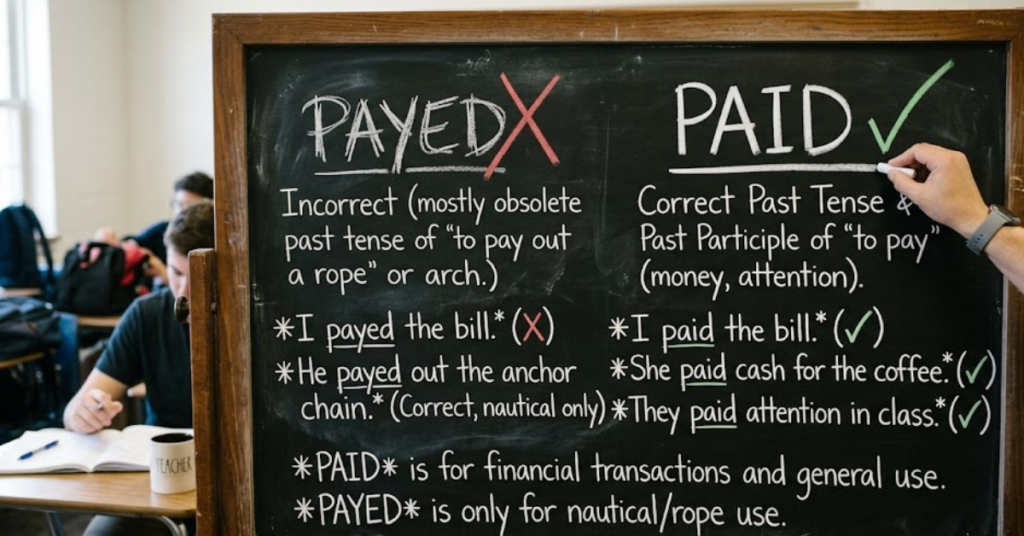

English is full of tricky word pairs, but few confuse writers as often as payed vs paid. At first glance, both words seem correct because they come from the verb “pay.” However, only one is commonly used in everyday writing.
If you’ve ever typed “payed attention” or “payed money” and wondered whether it was right, you’re not alone. The confusion is extremely common because spell-check tools sometimes miss the mistake. In this guide, you’ll learn the exact difference between payed vs paid, when each word should be used, and how to avoid common grammar errors.
By the end, you’ll confidently know which spelling belongs in emails, essays, business writing, and casual conversations.
What Does “Paid” Mean?
The word paid is the standard past tense and past participle of the verb pay.
It refers to:
- Giving money
- Settling a debt
- Receiving wages
- Showing attention or respect
Examples of “Paid”
- I paid the electricity bill yesterday.
- She paid attention during the lecture.
- They paid money for concert tickets.
- He finally paid off his loan.
In almost every modern English situation, paid is the correct spelling.
What Does “Payed” Mean?
Here’s where things get interesting. While many people assume “payed” is simply a misspelling of “paid,” it is actually a real word — but it’s used in a very specific nautical context.
Definition of “Payed”
In sailing and maritime language, payed refers to:
- Sealing a ship with tar or pitch
- Letting out rope or cable slowly
Examples of “Payed”
- The sailors payed the deck seams with tar.
- The crew carefully payed out the anchor rope.
Unless you work with ships, boating, or maritime history, you will almost never need to use “payed.”
Payed vs Paid Grammar Rules
Understanding the grammar behind payed vs paid makes the difference easier to remember.
| Word | Meaning | Common Usage |
| Paid | Past tense of “pay” | Everyday English |
| Payed | Nautical term | Maritime contexts only |
Quick Grammar Tip
If your sentence involves:
- Money
- Bills
- Attention
- Respect
- Salary
- Cost
Then the correct word is always paid.
Payed vs Paid Attention
One of the most searched grammar questions online is “payed vs paid attention.”
The correct phrase is:
Paid attention
Payed attention
Correct Examples
- She paid attention to every detail.
- Students who paid attention performed better.
- I should have paid attention to the warning signs.
The phrase “paid attention” means to focus or concentrate. Since it’s not related to sailing or ropes, “payed” is incorrect here.
Payed vs Paid Money
Another common mistake involves financial writing.
The correct form is:
Paid money
Payed money
Correct Examples
- We paid money for the repairs.
- He paid cash for the car.
- They already paid the invoice.
Whenever you’re discussing transactions, expenses, wages, or debts, use paid.
Why People Confuse Payed and Paid
The confusion exists because English usually forms past tense verbs by adding “-ed.”
For example:
- Walk → Walked
- Jump → Jumped
- Call → Called
So naturally, many writers assume:
- Pay → Payed
But “pay” is an irregular verb, meaning its past tense changes differently:
- Pay → Paid
English contains many irregular verbs like this:
- Say → Said
- Make → Made
- Sell → Sold
Easy Trick to Remember Payed vs Paid
A simple memory trick can help you avoid mistakes.
Think About Money
If your sentence has anything to do with:
- Money
- Work
- Bills
- Attention
- Cost
Use paid.
Think About Ships
If you’re talking about:
- Boats
- Ropes
- Tar
- Sailing
Then “payed” might be correct.
For 99% of writers, paid is the word you need.
Payed vs Paid Examples
Here are side-by-side examples to make the difference crystal clear.
| Incorrect | Correct |
| I payed the bill. | I paid the bill. |
| She payed attention. | She paid attention. |
| They payed money online. | They paid money online. |
| He payed his workers weekly. | He paid his workers weekly. |
Rare Correct Use of “Payed”
- The sailors payed out the rope slowly.
Common Mistakes Writers Make
1. Trusting Spell Check Too Much
Some grammar tools don’t flag “payed” because it’s technically a valid word.
2. Assuming Every Verb Takes “-ed”
English irregular verbs break normal grammar rules.
3. Mixing Up Specialized Vocabulary
Many people encounter “payed” in old books or maritime texts and assume it works everywhere.
Is “Payed” Ever Acceptable in Modern English?
Yes — but only in specialized nautical language.
Outside maritime contexts, using “payed” will almost always appear as a grammar mistake.
Professional writers, teachers, editors, and employers generally expect:
- Paid attention
- Paid money
- Paid in full
Not “payed.”
How Dictionaries Define Paid and Payed
Most major dictionaries recognize both words but clearly separate their meanings.
Paid
- Standard past tense of “pay”
- Used in everyday communication
Payed
- Nautical term related to ropes and sealing ships
This distinction has remained consistent across modern English grammar references.
Why Correct Usage Matters
Using the correct spelling improves:
- Professional writing
- Academic papers
- Business communication
- Social media credibility
Grammar mistakes may seem small, but they can affect how readers perceive your expertise and attention to detail.
FAQs About Payed vs Paid
Is it payed or paid?
In almost all cases, the correct word is paid. “Payed” is only used in maritime contexts.
Is “payed attention” correct?
No. The correct phrase is paid attention.
Why is paid spelled differently?
“Pay” is an irregular verb, so its past tense becomes “paid” instead of “payed.”
Is payed a real word?
Yes, but it’s a specialized nautical term related to ships and ropes.
Which is correct: payed money or paid money?
The correct phrase is paid money.
Can I use “payed” in formal writing?
Only if you are specifically discussing maritime or sailing topics.
Conclusion
Understanding payed vs paid is simpler once you know the core rule: paid is the correct past tense of “pay” in everyday English, while payed belongs almost exclusively to nautical terminology.
Whether you’re writing emails, blog posts, essays, or business documents, phrases like:
- paid attention
- paid money
- paid in full
are always correct.
Remember this easy shortcut: if your sentence involves money, work, or attention, choose paid. Save “payed” for ships and sailors.
Want to improve your grammar even further? Explore related guides on commonly confused English words and professional writing tips to sharpen your communication skills.