
The confusion between faring vs fairing is more common than you might think. At first glance, the two words look almost identical, but they belong to completely different worlds of meaning. One is related to progress and well-being, while the other is deeply rooted in engineering and design.
Understanding the difference between faring vs fairing not only improves your grammar but also helps you avoid embarrassing writing mistakes in professional and academic contexts.
Let’s break it down in a simple, human way.
What Does “Faring” Mean?
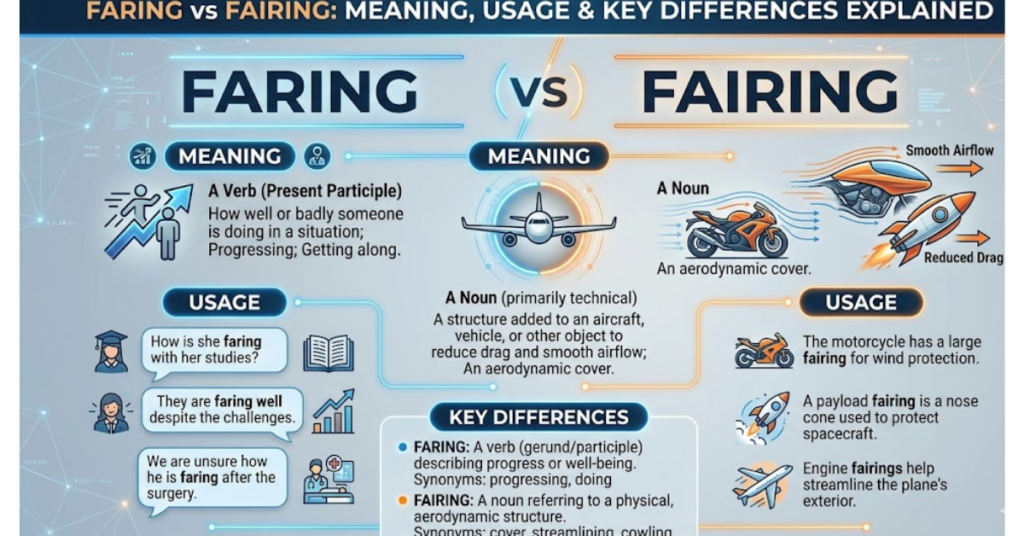
The word faring comes from the verb “fare,” which means to progress, perform, or get along in a certain way. It’s commonly used when asking or describing how someone is doing.
Common meaning of faring:
- How someone is doing in life or health
- How a situation is progressing
- How well or badly something is going
Examples of “faring” in sentences:
- How are you faring after the surgery?
- The company is faring better than expected this year.
- She is faring well in her new job.
Key takeaway:
Faring = progress or condition of someone/something
What Does “Fairing” Mean?
Now let’s talk about fairing—a completely different word despite the similar spelling.
A fairing is a noun, mostly used in engineering, aviation, and automotive design. It refers to a smooth structure added to a vehicle to reduce drag and improve aerodynamics.
Where “fairing” is commonly used:
- Motorcycles
- Airplanes
- Rockets and spacecraft
Examples of “fairing” in sentences:
- The motorcycle’s fairing reduces wind resistance at high speeds.
- Engineers redesigned the aircraft fairing to improve fuel efficiency.
- The rocket fairing protects the payload during launch.
Key takeaway:
Fairing = physical structure used for aerodynamics
Faring vs Fairing: Key Differences
To make things crystal clear, here’s a quick comparison:
| Feature | Faring | Fairing |
| Part of speech | Verb form | Noun |
| Meaning | How someone is doing | Aerodynamic structure |
| Usage context | Everyday language | Engineering, aviation |
| Example | “How are you faring?” | “Bike fairing reduces drag.” |
Even though they sound similar, their meanings have no connection.
Why People Confuse Faring vs Fairing
The confusion happens mainly because:
- They are spelled almost the same
- They are pronounced similarly in fast speech
- Auto-correct tools sometimes misinterpret them
- Both appear in written English but in very different contexts
A simple trick to remember:
- Faring = feelings / situation
- Fairing = machines / vehicles
Real-Life Usage Tips
If you want to avoid mistakes with faring vs fairing, keep these tips in mind:
- Use faring when talking about health, progress, or situations
- Use fairing only when discussing vehicles or aerodynamic design
- If you can replace the word with “doing,” it’s probably faring
- If it involves speed, wind, or machinery, it’s likely fairing
FAQs About Faring vs Fairing
1. Is “faring” a real word?
Yes, “faring” is the present participle of “fare,” meaning how someone is doing or progressing.
2. What is a fairing in simple words?
A fairing is a cover or structure added to vehicles like bikes or planes to reduce air resistance.
3. Can “fairing” be used in daily conversation?
Not usually. It’s mostly used in technical fields like engineering and aviation.
4. How do I remember faring vs fairing easily?
Think: faring = feelings, fairing = machines. This simple association helps avoid confusion.
5. Are faring and fairing related in meaning?
No, they are completely unrelated despite their similar spelling.
Conclusion: Faring vs Fairing Made Simple
The difference between faring vs fairing comes down to context. One describes how someone or something is doing, while the other refers to a physical aerodynamic structure used in machines.
Once you understand the meaning behind each word, you’ll never mix them up again. Whether you’re writing professionally or casually, using the correct term improves clarity and credibility.
If you found this helpful, you might also want to explore more confusing word pairs in English to sharpen your grammar even further.