
Have you ever come across the phrase “acceptions vs exceptions” and wondered if both words are correct—or if one of them is even real? You’re not alone. This is a common confusion in English grammar, especially among learners and even native speakers.
The focus keyword acceptions vs exceptions often appears in searches because people are trying to understand whether “acceptions” is a valid word and how it differs from “exceptions.” In reality, only one of these words is widely accepted in standard English, and the difference is more important than it looks.
In this guide, we’ll break down the meaning, usage, and correct spelling so you can confidently avoid this common mistake.
What Does “Exceptions” Mean?
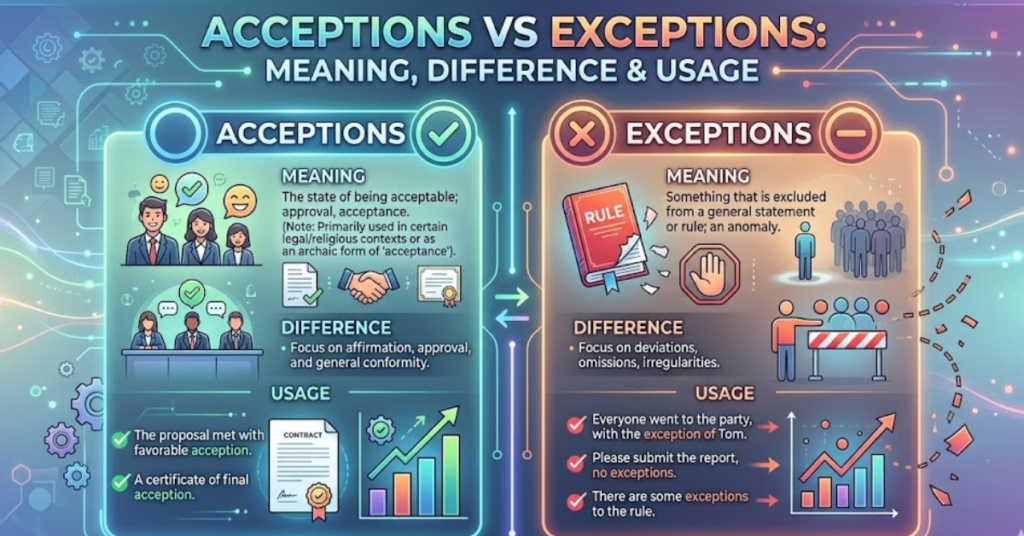
The word exceptions is a standard English term used in everyday language. It refers to something that does not follow a rule, pattern, or general statement.
Simple meaning:
An exception is something or someone that is excluded from a rule.
Examples:
- Everyone must attend the meeting, with no exceptions.
- There are always exceptions to grammar rules.
- He is usually calm, but today was an exception.
Key takeaway:
“Exceptions” is correct, widely used, and essential in both formal and informal English.
Is “Acceptions” a Real Word?
Here’s where the confusion starts in acceptions vs exceptions.
The word “acceptions” is not commonly accepted in modern English. It is rarely used and is often considered incorrect in standard writing.
Why the confusion exists:
- It looks similar to “accept” and “acceptance”
- Some older or non-standard texts may include it
- Typing errors often create this spelling
Important note:
In most cases, when people write “acceptions,” they actually mean acceptance or simply exceptions.
Acceptions vs Exceptions: Key Differences
Let’s clear things up in a simple comparison:
| Feature | Acceptions (rare/non-standard) | Exceptions (correct usage) |
| Usage | Rare, outdated, or incorrect | Common and standard |
| Meaning | Not clearly defined in modern English | Something excluded from a rule |
| Grammar status | Not accepted in formal English | Fully accepted |
| Example use | Very uncommon | Widely used in writing and speech |
Bottom line:
When comparing acceptions vs exceptions, only “exceptions” is correct in modern English usage.
Common Usage of “Exceptions” in Real Life
Understanding how “exceptions” works in real sentences helps reinforce correct usage.
Everyday examples:
- “No smoking allowed, with few exceptions.”
- “She makes an exception for close friends.”
- “Rules are important, but there are always exceptions.”
In professional writing:
- Legal documents often include exceptions to rules
- Policies usually list exceptions and conditions
- Academic writing uses “exceptions” to discuss anomalies
Why People Confuse Acceptions vs Exceptions
This confusion usually comes from:
- Similar pronunciation
- Spelling assumptions based on “accept”
- Lack of exposure to correct usage
- Auto-correct or typing errors
Language evolves, but standard grammar still prefers clarity and consistency—this is why “exceptions” dominates.
How to Remember the Correct Word
Here’s a simple trick:
- EX-ception = EXcluding something from a rule
- Think of “EX” as “outside the rule”
So whenever you’re unsure, remember:
If something breaks a rule, it’s an exception, not an “acception.”
FAQs About Acceptions vs Exceptions
1. Is “acceptions” a correct English word?
No, “acceptions” is not commonly recognized in modern English grammar. It is generally considered incorrect or outdated.
2. What is the correct spelling: acceptions or exceptions?
The correct spelling is exceptions.
3. Why do people search for acceptions vs exceptions?
Most people are confused due to spelling similarity and assume both words exist, but only “exceptions” is standard.
4. Can “acception” ever be used?
In very rare historical or non-standard contexts, it may appear, but it is not used in modern English writing.
5. What does “exceptions” mean in simple terms?
It means something that is excluded from a rule or does not follow the usual pattern.
Conclusion
The confusion around acceptions vs exceptions is common, but the answer is straightforward: only exceptions is correct in standard English. It refers to something that breaks or does not follow a rule, while “acceptions” is not widely accepted in modern usage.
If you want to improve your grammar accuracy, focusing on commonly confused words like this is a great start. Understanding the difference helps you write more confidently and avoid simple mistakes in both academic and professional communication.