
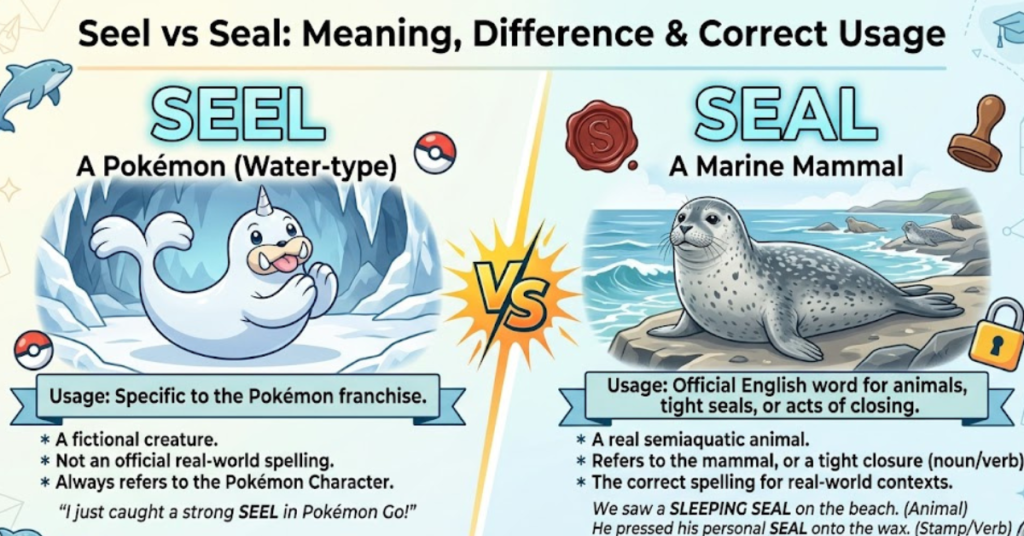

English can be tricky, especially when two words look almost the same but carry very different meanings. One such commonly searched comparison is seel vs seal. At first glance, they may seem like simple spelling variations, but they actually have distinct meanings and uses.
If you’ve ever wondered whether “seel” is just a misspelling of “seal” or if both are correct in different contexts, you’re not alone. In this guide, we’ll break down seel vs seal, explain their definitions, usage, origins, and help you avoid common mistakes in writing and conversation.
Let’s settle the confusion once and for all.
What Does “Seal” Mean?
The word seal is widely used in modern English and has several meanings depending on the context.
Common Meanings of Seal
1. Seal as an Animal
A seal is a marine mammal that lives in oceans and coastal waters. Seals are known for their smooth bodies, flippers, and playful swimming behavior.
Example:
- We saw a baby seal resting on the beach.
2. Seal as a Closure
A seal can refer to something used to close or secure an object tightly.
Examples:
- Please check the seal on the water bottle.
- The envelope had a wax seal.
3. Seal as an Official Mark
It can also mean an official stamp or symbol of authority.
Example:
- The certificate carried the university’s official seal.
4. Seal as a Verb
As a verb, seal means to close tightly, finalize, or confirm something.
Examples:
- Seal the box before shipping.
- They sealed the deal after weeks of negotiation.
What Does “Seel” Mean?
Unlike “seal,” the word seel is much less common in modern English.
Definition of Seel
Seel is an old or archaic English word that traditionally means:
- To close the eyes of a falcon partially by sewing the eyelids together (used in falconry)
- In some historical contexts, to blind or shut
This word is rarely used today outside of literature, poetry, or historical writing.
Example:
- The falconer would seel the hawk during training.
Because of its rarity, many people assume “seel” is simply a typo of “seal.”
Seel vs Seal: The Main Difference
Here’s the simplest way to understand seel vs seal:
| Word | Meaning | Common Usage |
| Seal | Animal, closure, official stamp, close tightly | Very common |
| Seel | Archaic word related to partially closing eyes | Very rare |
In everyday English, seal is almost always the correct word.
Is “Seel” a Misspelling of “Seal”?
Most of the time—yes.
When people search for seel vs seal, they are often trying to determine whether “seel” is an incorrect spelling of “seal.” In regular writing such as emails, essays, and business communication, using “seel” instead of “seal” is usually considered a spelling mistake.
Example of Incorrect Usage
Please seel the package before delivery.
Correct Usage
Please seal the package before delivery.
Unless you’re discussing falconry or quoting old literature, seal is the word you need.
Why Do People Confuse Seel and Seal?
There are a few reasons this confusion happens:
Similar Pronunciation
Both words sound almost identical in many accents.
Typing Errors
Autocorrect doesn’t always catch uncommon spelling mistakes.
Lack of Familiarity
Since “seel” is rarely used, people may assume it’s an acceptable spelling variation.
Regional Search Habits
Some users search “seel vs seal” simply to confirm proper spelling.
Examples of Seal in Everyday Sentences
Here are some practical examples using seal correctly:
- Make sure you seal the container tightly.
- The company’s official seal was printed on the document.
- We watched seals swimming near the harbor.
- She sealed the letter with red wax.
These examples show how versatile and common the word is.
Examples of Seel in Literary or Historical Context
Because seel is rare, you’ll mostly find it in older texts.
Example Sentences
- The bird was seeled before training.
- Shakespeare used old English words that included forms similar to seel.
This usage is highly specialized and not common in modern writing.
Quick Tips to Remember Seel vs Seal
Use this simple memory trick:
Think of “Seal” for Everyday Life
- Seal a package
- Seal a deal
- Seal the bottle
- Animal seal
Think of “Seel” for Old Literature
- Rare
- Historical
- Falconry-related
If you’re writing for modern readers, seal is almost always the safer choice.
Common Related Searches
People searching for seel vs seal also often look for:
- seal spelling meaning
- is seel a real word
- seal or seel correct spelling
- seal definition in English
- archaic English words like seel
These related terms help clarify the broader confusion around spelling and usage.
FAQs About Seel vs Seal
Is seel a real word?
Yes, seel is a real word, but it is archaic and rarely used today. It mainly appears in historical texts and falconry references.
Which is correct: seel or seal?
In most modern contexts, seal is correct. “Seel” is only used in very specific old-fashioned contexts.
Can I use seel instead of seal?
Generally, no. Unless you’re writing about falconry or quoting historical literature, “seel” should not replace “seal.”
Why does seel appear in some dictionaries?
Because it is a legitimate historical English word. Dictionaries often preserve old words even if they are no longer commonly used.
Is seal only used for animals?
No. “Seal” can refer to an animal, a closure, an official stamp, or the action of closing something securely.
Conclusion
Understanding seel vs seal is easier once you know the context. Seal is the standard modern English word used for animals, closures, official marks, and actions like closing or finalizing something. Seel, on the other hand, is an old and uncommon word mostly tied to falconry and historical texts.
For everyday writing, professional communication, and casual conversation, seal is almost always the right choice.
The next time you pause over seel vs seal, remember this simple rule: if it sounds modern, practical, and familiar—it’s probably seal.