
If you’ve ever paused mid-sentence wondering “atleast or at least”, you’re not alone. It’s one of those small grammar questions that trips up even confident writers.
Let’s clear it up right away: “at least” is correct, while “atleast” is not a standard word in English. Simple—but there’s more to understand if you want to use it confidently in real writing.
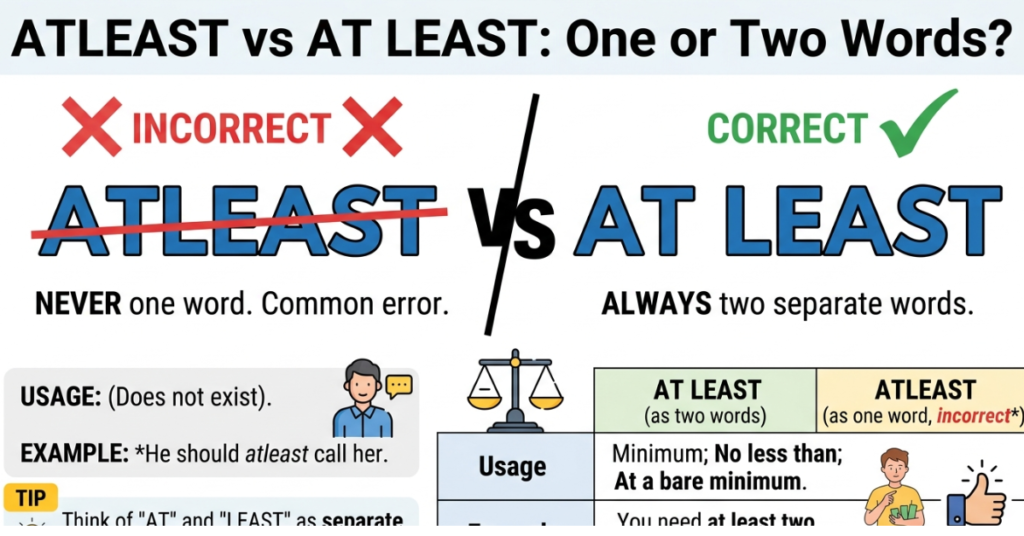
Atleast or At Least: The Correct Answer
So, which is correct atleast or at least?
Correct:
- at least (two separate words)
Incorrect:
- atleast (not accepted in standard English)
If you’re asking what is correct atleast or at least, the answer is always “at least.”
What Does “At Least” Mean?
Understanding the meaning makes it easier to remember the correct form.
“At least” definition:
It means:
- A minimum amount
- No less than
- Sometimes used to soften a statement or show a positive side
Examples:
- “Bring at least 5 people to the meeting.”
- “It’s not perfect, but at least it works.”
This covers both quantity and reassurance.
Atleast or At Least Meaning in Simple Terms
When people search “atleast or at least meaning”, they’re usually trying to understand usage.
In everyday language:
- At least = minimum or something positive in a situation
Think of it as:
“No less than this” or “if nothing else.”
Why “Atleast” Is Incorrect
You might see “atleast” online, especially in casual typing—but it’s not grammatically correct.
Reasons:
- It’s not recognized in standard dictionaries
- It doesn’t follow English spacing rules
- It’s considered a spelling mistake in formal writing
So if you’re wondering these words, always go with the two-word version.
At Least Examples in Real Sentences
Seeing examples helps lock it in.
Common usage examples:
- “You should sleep at least 7 hours.”
- “There were at least 100 people at the event.”
- “At least we finished the project on time.”
These examples show how flexible the phrase is in everyday conversation.
At Least Synonyms You Can Use
If you want variety in your writing, here are some alternatives.
Synonyms for “at least”:
- Minimum
- At a minimum
- No less than
- At the very least
These work well depending on the tone and context.
Atleast or At Least in Grammar Rules
Let’s break it down from a grammar perspective.
Key rule:
- “At least” is a phrase, not a single word
It combines:
- “At” (a preposition)
- “Least” (a superlative adjective)
Together, they form a meaningful expression—but they stay separate.
At Least in Different English Variants (UK & Others)
The rule is the same worldwide.
In all major English variants:
- British English
- American English
- Australian English
“At least” is always correct.
Common Mistakes to Avoid
Here are a few quick pitfalls:
Incorrect:
- atleast I tried
- bring atleast 10 items
Correct:
- at least I tried
- bring at least 10 items
A simple space makes all the difference.
At Least in Other Languages (Example: Tagalog)
If you’re curious about atleast or at least in Tagalog, translations vary based on context.
Common equivalents:
- “kahit papaano” (in reassuring contexts)
- “hindi bababa sa” (for minimum quantity)
This shows how meaning shifts slightly depending on usage.
FAQs About Atleast or At Least
1. Is it atleast or at least?
The correct form is “at least.”
2. Is “atleast” ever correct?
No, it’s considered incorrect in standard English.
3. What does “at least” mean?
It means a minimum amount or a positive fallback in a situation.
4. Can I use “at least” in formal writing?
Yes, it’s perfectly acceptable in both formal and informal contexts.
5. Why do people write “atleast”?
Mostly due to typing habits or misunderstanding—it’s a common mistake.
Final Thoughts: Keep It Simple and Correct
So, atleast or at least—what’s the final answer? Always go with “at least.” It’s correct, widely accepted, and easy to use once you understand its meaning.
It might seem like a small detail, but getting these basics right can make your writing clearer and more professional. The next time you hesitate, just remember: two words, not one.
Want to sharpen more grammar skills like this? Keep exploring—you’ll be surprised how quickly your writing improves.