
If you’ve ever wondered how life carries its instructions from one generation to the next, the answer lies in DNA—and more specifically in its building blocks. One of the most common biology questions students and curious readers ask is: which nitrogenous bases are found in DNA?
DNA, or deoxyribonucleic acid, stores genetic information using four chemical bases that pair in a very precise way. These nitrogenous bases act like letters in a biological alphabet, forming the “code of life” that determines everything from eye color to how cells function.
In this article, we’ll break down which nitrogenous bases are found in DNA, how they work, and why they are essential for life as we know it.
What Are Nitrogenous Bases in DNA?
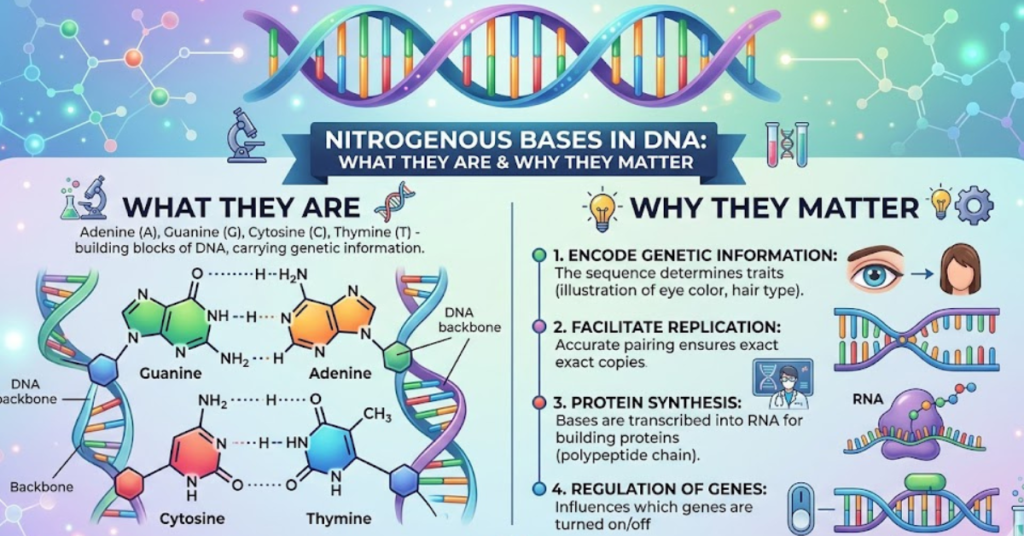
Nitrogenous bases are organic molecules that contain nitrogen and form the core of DNA’s structure. When people ask which nitrogenous bases are found in DNA, they are referring to the four specific bases that make up the genetic code.
These bases pair up in a very specific way to maintain the double-helix structure of DNA and ensure accurate replication.
The Four Nitrogenous Bases Found in DNA
The correct answer to which nitrogenous bases are found in DNA is simple: there are four of them.
1. Adenine (A)
- A purine base (double-ring structure)
- Always pairs with Thymine
- Plays a key role in energy transfer and genetic coding
2. Thymine (T)
- A pyrimidine base (single-ring structure)
- Pairs specifically with Adenine
- Unique to DNA (replaced by Uracil in RNA)
3. Cytosine (C)
- A pyrimidine base
- Pairs with Guanine
- Involved in gene regulation and stability of DNA
4. Guanine (G)
- A purine base
- Pairs with Cytosine
- Important for strong bonding in DNA structure
Base Pairing Rules in DNA
Understanding which nitrogenous bases are found in DNA also means understanding how they interact.
DNA follows strict base-pairing rules:
- Adenine (A) ↔ Thymine (T)
- Cytosine (C) ↔ Guanine (G)
These pairs are held together by hydrogen bonds, which keep the DNA double helix stable yet flexible enough for replication.
Why base pairing matters:
- Ensures accurate DNA replication
- Maintains genetic stability
- Allows genetic information to be copied correctly during cell division
Purines vs Pyrimidines
To fully understand which nitrogenous bases are found in DNA, it helps to know how they are classified.
Purines (double-ring structure):
- Adenine (A)
- Guanine (G)
Pyrimidines (single-ring structure):
- Cytosine (C)
- Thymine (T)
This classification is important because a purine always pairs with a pyrimidine, keeping the DNA structure uniform.
Role of Nitrogenous Bases in DNA Function
The nitrogenous bases in DNA are not just structural components—they carry genetic information.
They are responsible for:
- Encoding proteins through sequences of bases
- Passing genetic traits from parents to offspring
- Guiding cell growth, repair, and function
- Regulating gene expression
Even a small change in these bases (called a mutation) can affect how a protein is made.
DNA vs RNA Bases Quick Comparison
A common follow-up to which nitrogenous bases are found in DNA is how DNA differs from RNA.
| DNA Base | RNA Equivalent |
| Adenine (A) | Adenine (A) |
| Thymine (T) | Uracil (U) |
| Cytosine (C) | Cytosine (C) |
| Guanine (G) | Guanine (G) |
The key difference is that RNA replaces thymine with uracil.
Why These Bases Are So Important
Without these four nitrogenous bases, life as we know it wouldn’t exist. They:
- Store genetic instructions
- Enable inheritance
- Support evolution and diversity
- Control how proteins are built
So when asking which nitrogenous bases are found in DNA, you’re really asking about the foundation of biological life itself.
FAQs About Nitrogenous Bases in DNA
1. Which nitrogenous bases are found in DNA?
DNA contains four nitrogenous bases: adenine, thymine, cytosine, and guanine.
2. Why are there only four bases in DNA?
These four bases are chemically stable and allow precise pairing, which is essential for accurate genetic coding.
3. What is the base pairing rule in DNA?
Adenine pairs with thymine, and cytosine pairs with guanine.
4. How do nitrogenous bases store genetic information?
The sequence of bases forms genetic code, which determines how proteins are made.
5. What is the difference between DNA and RNA bases?
RNA uses uracil instead of thymine, while the other bases remain the same.
Conclusion
To sum it up, the answer to which nitrogenous bases are found in DNA is straightforward: adenine, thymine, cytosine, and guanine. These four molecules form the genetic alphabet of life, working together in precise pairs to store and transmit genetic information.
Understanding these bases is the first step in grasping how genetics, heredity, and biological processes work. If you’re curious about biology, exploring DNA structure and replication is a great next step to deepen your knowledge.