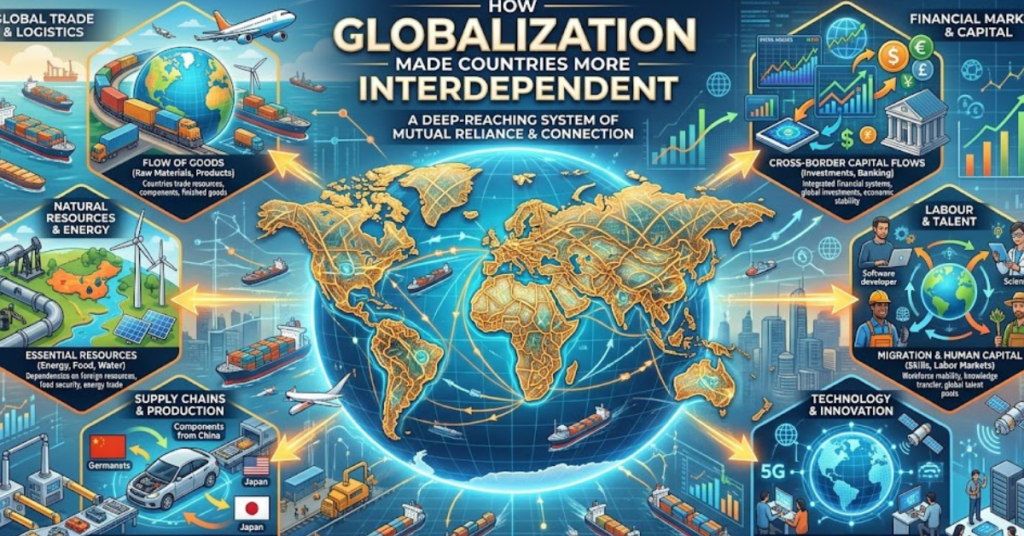

In today’s connected world, no country truly operates in isolation. From the smartphones we use to the food on our tables, globalization has woven nations together in ways that were unimaginable just a few decades ago. But how has globalization made countries more interdependent? The answer lies in trade, communication, finance, culture, and shared global challenges. This article explores five key ways globalization has increased interdependence among countries, making cooperation more essential than ever.
1. Global Trade and Supply Chains
One of the clearest ways globalization has made countries more interdependent is through international trade. Countries now rely heavily on imports and exports to meet their needs.
How trade increases interdependence:
- Raw materials come from one country
- Manufacturing happens in another
- Products are assembled elsewhere
- Finished goods are sold worldwide
For example, a single car might include:
- Steel from China
- Electronics from Japan
- Design from Germany
- Assembly in Mexico
This complex global supply chain means disruptions in one country can affect production worldwide.
LSI Keywords: global trade, international markets, supply chains, imports and exports
2. Technology and Communication Networks
Advances in technology have connected countries like never before. The internet, smartphones, and digital platforms allow instant communication across borders.
Examples of technological interdependence:
- Businesses outsource services to other countries
- International remote teams collaborate daily
- Global tech companies rely on worldwide talent
- Cloud computing connects global data systems
Because of this, economies now depend on shared digital infrastructure, making cooperation crucial.
LSI Keywords: digital globalization, communication technology, global connectivity
3. Financial Interdependence
Globalization has also linked financial systems. Investments, loans, and stock markets are interconnected across countries.
Key ways finance creates interdependence:
- Foreign direct investment (FDI) flows between nations
- Global banks operate across multiple countries
- Currency exchange affects international trade
- Economic crises spread quickly worldwide
For instance, the 2008 financial crisis started in the U.S. but impacted economies globally. This shows how closely tied national economies have become.
LSI Keywords: global economy, international finance, economic interdependence
4. Cultural Exchange and Migration
Globalization has encouraged the movement of people, ideas, and culture. Countries influence each other through entertainment, education, and migration.
Cultural interdependence includes:
- International students studying abroad
- Global tourism industries
- Shared music, movies, and fashion trends
- Multinational workplaces
This cultural exchange fosters understanding but also increases reliance on international collaboration.
LSI Keywords: cultural globalization, migration, international tourism
5. Shared Global Challenges
Perhaps the most important reason globalization has made countries more interdependent is that many problems are now global.
Examples of shared challenges:
- Climate change
- Pandemics (like COVID-19)
- Cybersecurity threats
- Energy shortages
- Environmental protection
No single country can solve these alone. Nations must work together through international organizations and agreements.
LSI Keywords: global cooperation, international organizations, climate change collaboration
Quick Summary: Five Ways Globalization Increased Interdependence
- Global trade and supply chains
- Technology and communication networks
- Financial connections
- Cultural exchange and migration
- Shared global challenges
FAQs
1. What does interdependence mean in globalization?
Interdependence refers to countries relying on each other for goods, services, technology, and solutions to global problems.
2. Why has globalization increased interdependence?
Globalization connects economies, cultures, and political systems, making cooperation necessary for growth and stability.
3. Is globalization good for interdependence?
Yes, it promotes collaboration and economic growth, but it also means countries can be affected by problems elsewhere.
4. What is an example of global interdependence?
A smartphone designed in the U.S., assembled in China, and sold worldwide is a strong example.
5. How does globalization affect developing countries?
It provides access to markets and technology but also increases reliance on global economic conditions.
Conclusion
So, how has globalization made countries more interdependent? Through trade, technology, finance, culture, and shared global challenges, nations now rely on each other more than ever. This interdependence encourages cooperation, boosts economic growth, and helps tackle worldwide issues collectively. As globalization continues to evolve, understanding these connections becomes essential for governments, businesses, and individuals alike.