
If you’ve ever compared two shapes and thought they looked exactly the same, you were probably noticing congruence. But what is the meaning of congruent in maths, and why is it so important? In mathematics, congruent shapes are figures that have the same size and shape, even if they are positioned differently.
Understanding congruence helps students solve geometry problems, prove theorems, and recognize patterns more easily. In this guide, we’ll break down the concept in simple terms, explore examples, and show how congruence works in real-life situations.
What Is the Meaning of Congruent in Maths?
The meaning of congruent in maths is simple:
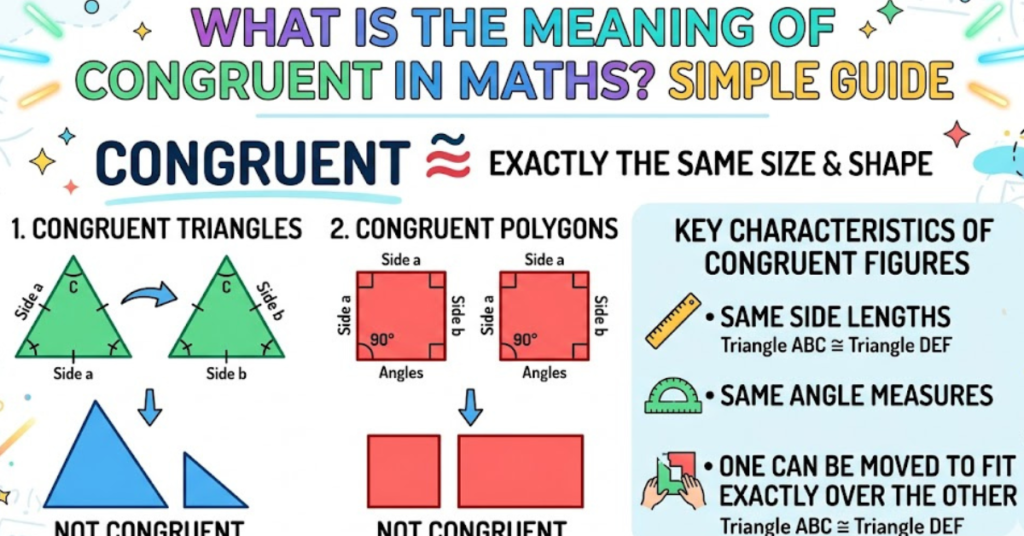
Two figures are congruent if they are identical in size and shape. When one figure can be placed exactly on top of another and they match perfectly, they are congruent.
Key Points
- Same shape
- Same size
- Can be flipped, rotated, or moved
- Still congruent if orientation changes
For example:
- Two squares with equal side lengths are congruent.
- Two triangles with the same angles and sides are congruent.
Congruent Symbol in Mathematics
The symbol used for congruent is:
≅
Example:
Triangle ABC is congruent to triangle DEF is written as:
△ABC ≅ △DEF
This means both triangles are identical in size and shape.
Examples of Congruent Shapes
Here are some everyday examples:
- Two identical coins
- Two same-sized books
- Two equal-length line segments
- Two squares with equal sides
Even if you rotate or flip one shape, they remain congruent.
Congruent Triangles Rules
Congruence is most commonly used with triangles. There are specific rules to prove triangles are congruent:
1. SSS Side-Side-Side
All three sides of one triangle equal the other.
2. SAS Side-Angle-Side
Two sides and the included angle are equal.
3. ASA Angle-Side-Angle
Two angles and the included side are equal.
4. AAS Angle-Angle-Side
Two angles and one side are equal.
5. RHS Right angle-Hypotenuse-Side
Used for right-angled triangles.
Congruent vs Similar Shapes
Students often confuse congruent and similar. Here’s the difference:
| Feature | Congruent | Similar |
| Same shape | Yes | Yes |
| Same size | Yes | No |
| Scale factor | 1 | Not always 1 |
| Example | Identical squares | Small & large square |
So, all congruent shapes are similar, but not all similar shapes are congruent.
Why Congruence Is Important in Maths
Understanding what is the meaning of congruent in maths helps in:
- Solving geometry proofs
- Understanding symmetry
- Construction and engineering
- Measuring objects accurately
- Learning advanced math concepts
It builds a strong foundation for algebra and trigonometry.
Real-Life Examples of Congruence
Congruence is everywhere around us:
- Tiles on a floor
- Playing cards
- Printed currency notes
- Window panels
- Smartphone icons
Manufacturers use congruence to ensure uniformity.
Common Mistakes Students Make
- Confusing congruent with equal numbers
- Ignoring orientation (rotation/flip)
- Assuming similar shapes are congruent
- Forgetting to check all sides and angles
FAQs About Congruence in Maths
What is the simple definition of congruent?
Congruent means two shapes have the same size and shape and match exactly when placed together.
Can congruent shapes be rotated?
Yes, rotation does not affect congruence.
Are congruent shapes always equal?
Yes, they are equal in both size and shape.
What is congruent in triangles?
Triangles are congruent when their sides and angles are exactly equal.
Is congruent the same as identical?
In maths, yes. Congruent figures are identical in size and shape.
Conclusion
Now you clearly understand what is the meaning of congruent in maths. Congruence simply means two shapes are exactly the same in size and shape, even if they’re rotated or flipped. This concept is essential in geometry, helps solve problems faster, and appears in everyday life more often than you might think.